Explore our top-tier turnkey manufacturing plants engineered for high yield, precision raw material dosing, and low carbon emissions.
Delivering full lifecycle assistance from feasibility studies to plant commissioning across 60+ countries.
The global construction industry is undergoing a structural transition driven by decarbonization mandates, severe skilled labor shortages, and stringent energy-efficiency regulations. Expanded Polystyrene (EPS) Cement Sandwich Panels have emerged as a disruptive technological solution in precast structural systems. Combining high flexural strength fiber cement or calcium silicate face sheets with a lightweight core matrix of Portland cement, expanded polystyrene beads, sand, and chemical admixtures, these composite panels deliver exceptional thermal insulation, fire ratings up to 4 hours, acoustic attenuation, and rapid structural assembly.
This industry whitepaper provides an exhaustive technical analysis for project developers, EPC contractors, building material investors, and manufacturing executives looking to procure an EPS Cement Sandwich Panel Production Line. As a primary OEM machinery engineer, China Amulite Group integrates advanced automated raw material batching, dynamic high-shear slurry mixing, multi-stage vertical or horizontal moulding systems, and SCADA-driven curing control to optimize return on investment (ROI) while minimizing total cost of ownership (TCO).
Strategic Market Insight: The global market for lightweight composite wall panels is projected to grow at a CAGR of 7.4% through 2032. Procurement decision-makers must look beyond initial machine capital expenditure (CAPEX) and evaluate lines based on slurry homogenization efficacy, yield loss ratios (<1.5%), energy consumption per square meter, and local raw material adaptability (e.g., utilizing fly ash or slag to reduce OPC usage).
Understanding the exact physical attributes of the finished wall panel is essential when sizing the production line's slurry dosing, EPS pre-expansion ratio, and curing chambers. Amulite production lines engineered for EPS cement sandwich panels produce panels compliant with international structural codes including ASTM C1289, EN 15283, and BS 476.
| Performance Parameter | Standard Benchmark Value | Amulite Optimized Standard | Test Standard Compliance |
|---|---|---|---|
| Density Class | 550 – 800 kg/m³ | 450 – 650 kg/m³ (Adjustable) | GB/T 23451-2023 / ASTM C567 |
| Flexural Failure Load | 1.5 to 2.0 × Panel Weight | > 2.5 × Panel Weight | EN 12467 Class 3 |
| Compressive Strength | 3.5 – 5.0 MPa | 5.5 – 7.2 MPa | ASTM C39 / ISO 1920-4 |
| Thermal Conductivity (λ) | 0.12 – 0.20 W/(m·K) | 0.065 – 0.085 W/(m·K) | ASTM C518 / EN 12667 |
| Airborne Sound Insulation (STC) | 38 – 42 dB (90mm panel) | 45 – 52 dB (90mm panel) | ISO 717-1 / ASTM E90 |
| Fire Resistance Rating | 2 to 3 Hours (A1 Non-combustible) | Up to 4 Hours (1000°C exposure) | BS 476 Part 22 / EN 1364-1 |
| Moisture Movement / Shrinkage | ≤ 0.06% | ≤ 0.035% | ASTM C1185 |
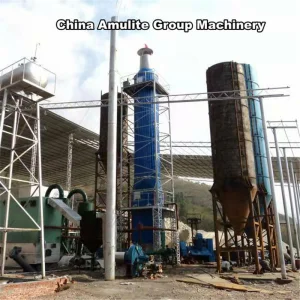
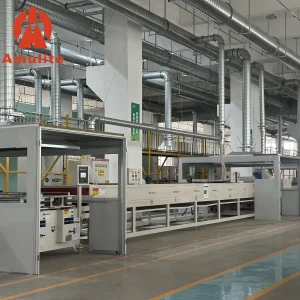
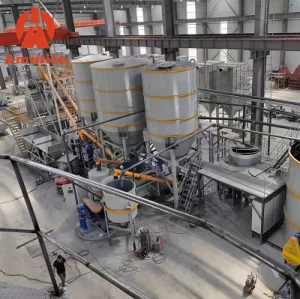
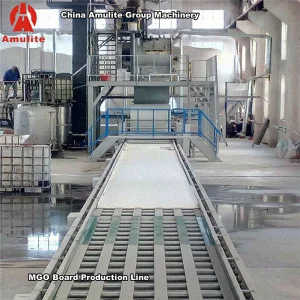
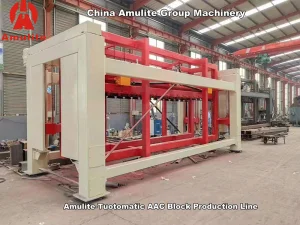
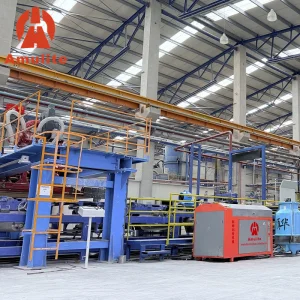
A modern, automated EPS cement wall panel manufacturing facility requires seamless integration between raw material storage, pneumatic conveying, automated dosing, specialized mixing, moulding, hydraulic compaction, and automated packaging. China Amulite Group divides the line into six automated subsystems:
Raw EPS beads are expanded from their initial bulk density (~600 kg/m³) down to 10–18 kg/m³ using precise steam injection chambers. The expanded beads pass through a multi-stage fluidized bed dryer and are pneumatically conveyed into aging silos where internal pressure stabilizes over 4 to 8 hours. Amulite's closed-loop thermal recovery system reclaims flash steam, cutting boiler fuel demands by up to 22%.
Ordinary Portland Cement (OPC 42.5/52.5), Class F Fly Ash, silica sand, and customized set-accelerators are metered via high-precision load cells (±0.2% accuracy). Water-reducing polycarboxylate ether (PCE) superplasticizers are micro-dosed into the mixing fluid to ensure low water-binder ratios (0.32–0.36) without sacrificing slurry fluid mechanics.
Standard concrete mixers fail when blending ultra-lightweight EPS beads with dense cementitious mortars, leading to bead flotation and density segregation. Amulite's proprietary twin-shaft forced mixer features counter-rotating helical paddles that generate intensive three-dimensional vortex flows, encapsulating every EPS bead in a micro-cement matrix within 120 seconds.
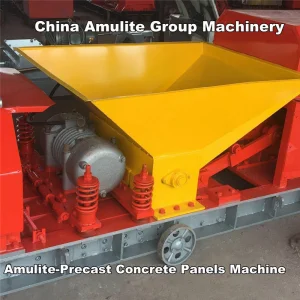
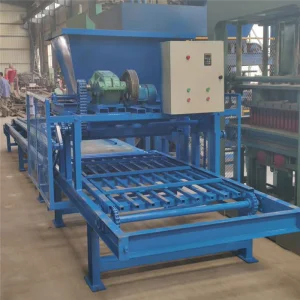
The core slurry is injected into multi-cavity mould cars equipped with automatic face-sheet feeding mechanisms (using high-density fiber cement or calcium silicate boards). Mould cars feature mirror-polished side plates, hydraulic locking mechanisms capable of withstanding 150 kN of internal expansion pressure, and automated core-grouting pipes to eliminate air pockets.
Mould cars enter radiant hot-water or low-pressure steam curing tunnels maintained at 55°C – 65°C. After 3 to 4 hours of accelerated hydration, panels achieve demoulding compressive strength (>2.5 MPa). Automated hydraulic turning machines turn the mould cars 90°, extract the cured sandwich panels, and transfer them to automatic stackers.
The demoulded panels are aligned by laser sensors and passed through automated edge-profiling machinery. Tongue-and-groove profiles, concave joints, and wiring channels are milled with sub-millimeter tolerances (±0.5 mm) before automatic stretch-wrapping and palletization.
When selecting your production line technology from global suppliers, evaluating structural capacity vs operational flexibility is critical. The decision matrix below outlines the primary machinery architectures offered by leading OEMs:
| Evaluation Parameter | Amulite Automated Vertical Mould Car Line | Conventional Horizontal Batch Line | Continuous Roll-Form Extrusion Line |
|---|---|---|---|
| Annual Production Capacity | 500,000 m² – 3,000,000 m² / year | 100,000 m² – 300,000 m² / year | 1,500,000 m² – 4,000,000 m² / year |
| Floor Footprint Requirement | Compact (2,500 m² – 4,500 m²) | Large (5,000 m² – 8,000 m²) | Very Long Linear (6,000 m²+) |
| Thickness Versatility | Highly Flexible (60mm – 200mm switch in mins) | Rigid (Requires complete mould change) | Fixed gauge extrusion dies |
| Operator Headcount per Shift | 4 – 6 Operators (PLC Automated) | 14 – 20 Operators (Manual heavy lifting) | 6 – 8 Skilled Technicians |
| Core Density Uniformity | Very High (Vibration + Hydraulic Pressure) | Moderate (Prone to bead segregation) | High |
| CAPEX Investment Scale | Optimal ROI Ratio | Low Initial CAPEX / High OPEX | Very High Initial CAPEX |
EPS Cement Sandwich Panels engineered by Amulite production equipment are deployed across diverse climate zones and architectural applications worldwide:
In mega-projects across Dubai, Singapore, and Jakarta, reducing dead-load structural weight is critical. Utilizing 90mm EPS cement sandwich panels instead of traditional 120mm hollow concrete blocks reduces structural wall mass by up to 65%. This enables structural engineers to shrink column dimensions, cut foundation rebar tonnage by 12–15%, and accelerate indoor wall construction speed by 400%.
In earthquake-prone regions such as Chile, Peru, and the Philippines, the male-female interlocking tongue-and-groove joint system of EPS sandwich panels provides superior shear displacement capacity. During seismic events, the panels absorb kinetic energy through micro-yielding at connected steel structural frames without brittle fracture or wall collapse.
Due to the micro-cellular air voids trapped inside expanded polystyrene beads, 150mm thick sandwich panels deliver an insulation U-value down to 0.42 W/(m²·K). This eliminates thermal bridging in agricultural processing plants, cold warehouses, and residential developments in sub-zero climates across Kazakhstan and Uzbekistan.
To succeed in international tenders, building panel products must fulfill strict regional building codes. China Amulite Group designs and certifies production machinery to meet global regulatory frameworks:
As Industry 4.0 transforms the building material sector, China Amulite Group leads the innovation curve by integrating IoT telematics, AI visual quality scanning, and cloud-based operational monitoring into our production equipment:
Inline ultrasonic viscometers inside the mixing tank measure live rheological properties during slurry blending. The system dynamically adjusts water dosing pumps to maintain consistent slump values regardless of ambient humidity or cement temperature variations.
High-resolution optical cameras installed on the discharge conveyor scan 100% of finished panels for micro-cracks, surface pitting, or edge chipping. Defective boards are flagged and automatically diverted to the re-work conveyor before packaging.
Vibration sensors on high-load mixer bearings, hydraulic oil temperature monitors, and pressure transducers stream operating metrics to an integrated Siemens SCADA interface. Machine operators receive proactive maintenance alerts days before component failure occurs, guaranteeing 98.5% plant operational uptime.
Expand your industrial footprint with Amulite's specialized machinery matrix for modern building materials.
Engineering clarity on production ROI, machine maintenance, raw material ratios, and plant commissioning.