



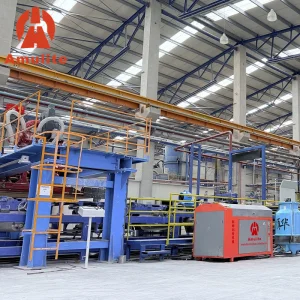
Engineered to deliver high flexural strength, moisture resistance, and fireproof compliance under Thailand's TIS standards.
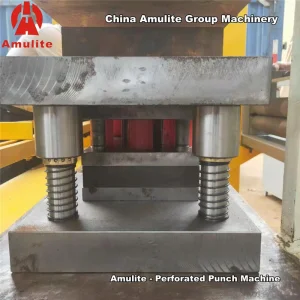
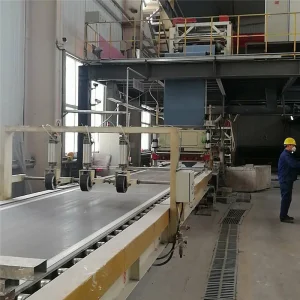
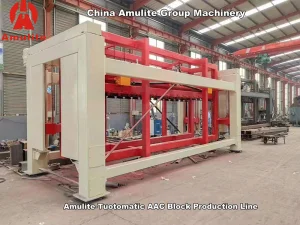
Strategic Insights for Infrastructure Developers, Material Manufacturers, and Factory Investors in Thailand.
The Metropolitan Area of Bangkok—extending into Samut Prakan, Pathum Thani, Nonthaburi, and connecting seamlessly with the Eastern Economic Corridor (EEC) provinces of Chachoengsao, Chonburi, and Rayong—is undergoing an unprecedented structural transition toward modern, rapid dry-construction methodologies. Driven by government transit-oriented developments (TOD), intense high-rise residential construction along Sukhumvit and Rama IX corridors, and expanded industrial logistics parks, traditional wet-masonry (brick and mortar) construction is being rapidly replaced by high-performance fiber cement boards and autoclaved calcium silicate panels.
Rapid mega-infrastructure growth requires light, durable exterior facade cladding, partition walls, and soffits compliant with Thai Industrial Standards Institute (TISI / TIS 1427-2540).
Under the Thailand Energy Efficiency Development Plan (EEDP), calcium silicate boards with thermal conductivity below 0.12 W/m·K significantly reduce HVAC cooling loads in Bangkok's commercial towers.
By establishing manufacturing hubs directly near Bangkok’s major shipping hubs (e.g., Laem Chabang Port & Bangkok Port), producers minimize freight costs while utilizing local quartz sand and fly ash.
How Modern Fiber Cement & Calcium Silicate Lines Achieve Maximum Yield, Energy Recovery, and Material Density.
The global production of non-asbestos building boards has shifted toward high-speed, fully automated Hatschek processes paired with multi-stage high-pressure hydrothermal autoclaving. In autoclaved board production, silica sand ($SiO_2$) reacts chemically with lime ($CaO$) and Portland cement under saturated steam conditions ($180^\circ\text{C}$ to $190^\circ\text{C}$ at $1.0 - 1.3\text{ MPa}$ pressure) over 10 to 14 hours. This hydro-thermal reaction converts raw slurries into a stable, non-hydrophilic crystalline matrix known as Tobermorite ($5CaO \cdot 6SiO_2 \cdot 5H_2O$), granting the final board unparalleled mechanical stability, zero moisture swelling, and extreme longevity.
| Performance Characteristic | Autoclaved Fiber Cement Board (FCB) | Autoclaved Calcium Silicate Board (CSB) | Test Standard / Benchmark |
|---|---|---|---|
| Target Density Range | 1.20 – 1.55 g/cm³ | 0.85 – 1.15 g/cm³ | ISO 8336 / EN 12467 |
| Flexural Strength (Bending) | ≥ 14.0 MPa (Category 3) | ≥ 9.0 MPa | TIS 1427-2540 / ASTM C1185 |
| Moisture Movement (Swelling) | ≤ 0.12% | ≤ 0.08% | ASTM C1186 |
| Thermal Conductivity ($\lambda$) | 0.18 – 0.24 W/(m·K) | 0.09 – 0.14 W/(m·K) | ISO 8302 |
| Fire Resistance Rating | Incombustible Class A1 | Incombustible Class A1 (4-Hour Fire Rated) | BS 476 Part 4/6/7 / EN 13501-1 |
| Asbestos Content | 100% Asbestos-Free (Cellulose Reinforced) | 100% Asbestos-Free | ISO 22262 compliance |
Step-by-Step Engineering Architecture of Amulite Turnkey Production Plants.
Cellulose pulp is refined via hydrapulpers and disc refiners to achieve proper Schopper-Riegler (°SR) freeness. Quartz silica is wet-milled in ball mills into fine slurry (< 45μm residue < 15%).
PLC-controlled automated gravimetric batching feeds Portland cement, silica slurry, refined cellulose fiber, and functional micro-additives into high-shear homogenization tanks.
Multi-vat (3 to 5 vats) Hatschek forming cylinders deposit micro-thin material layers onto a running felt. Vacuum dewatering boxes continuously extract moisture to form film layers.
The continuous film wraps around a master forming drum (making cylinder) until the precise target thickness (4mm to 25mm) is achieved. High-pressure water jets cut sheet edges cleanly.
Green boards are stacked on steel templates via automatic pneumatic vacuum stackers, pre-cured for 4–6 hours at 45°C, then transferred into autoclaves for high-pressure hydrothermal curing.
Cured boards undergo mechanical drying, face sanding (single/double side), edge chamfering, and automatic stack strapping ready for logistics distribution.
Delivering Scalable Capacity, Energy Conservation, and Long-Term Operating ROI.
Optimizing Local Aggregates to Reduce Import Dependency and Lower Unit Production Cost.
A primary failure mode for investors importing generic board plants into Thailand is the inability to adapt slurry chemistry to local raw materials. China Amulite Group’s process engineering team conducts preliminary XRF (X-ray Fluorescence) and XRD (X-ray Diffraction) analysis on Thai local inputs to configure custom slurry formulations.
| Raw Material Component | Recommended Thai Source / Specification | Proportion in FCB Formulation | Process Functionality |
|---|---|---|---|
| Ordinary Portland Cement (OPC Type 1) | SCG Cement / Elephant Brand (TIS 15 Type 1) | 35% – 45% | Primary hydraulic binder providing initial green strength and structural matrix. |
| Silica Quartz Sand / Powder | Rayong / Kanchanaburi deposits ($SiO_2 > 92\%$) | 40% – 50% | Provides reactive silica for the hydrothermal Tobermorite reaction during autoclaving. |
| Reinforcing Cellulose Fiber | Unbleached Kraft Pulp (Coniferous/Pine, $SR > 45^\circ$) | 7% – 10% | Provides high tensile strength, impact absorption, and wet-layer green cohesion. |
| Coal Fly Ash (Optional) | EGAT Mae Moh Power Plant (Class F Fly Ash) | 10% – 15% (Substitution) | Enhances slurry workability, reduces cement usage, and improves thermal insulation. |
| Flocculants & Process Additives | Anionic Polyacrylamide (PAM) | 0.02% – 0.05% | Accelerates solid-liquid separation and enhances fiber retention on forming vats. |
Empowering Board Producers with AI-Driven Quality Assurance and Ultra-Low Carbon Technology.
Inline laser non-contact gauges and ultrasonic sensors monitor sheet thickness variations down to ±0.1mm, triggering instant PLC servo adjustment on the forming roll.
Closed-loop water recycling systems reclaim 100% of process wash water, while heat exchangers capture flash steam from autoclaves to pre-heat boiler feed water.
Incorporating Limestone Calcined Clay Cement (LC3) and geopolymer binders reduces embodied carbon per square meter of board by up to 35%, aligning with global ESG standards.
Addressing Key Technical, Operational, and Investment Queries for the Bangkok & SE Asia Region.
A standard 5-million m²/year autoclaved fiber cement board line requires approximately 25,000 to 35,000 m² of industrial land. Utility demands typically average: Electric Power capacity of 1,200–1,500 kW; Saturated Steam requirement of 6 to 8 tons/hour (at 1.3 MPa pressure); and Water consumption of 15–20 m³/hour (with 100% recycling systems installed).
While both utilize similar autoclaved hydrothermal technology, Calcium Silicate Boards have a lower density (0.85–1.15 g/cm³), superior thermal insulation ($\lambda \le 0.12 \text{ W/m}\cdot\text{K}$), and high fire resistance, making them ideal for indoor ceiling grids, passive fire protection partitions, and acoustic wall linings. Fiber Cement Boards have higher density (1.20–1.55 g/cm³) and flexural strength (> 14 MPa), making them ideal for exterior building facades, heavy-duty floor decks, and weatherboards.
Yes. China Amulite Group provides turnkey engineering support including formulation fine-tuning to meet or exceed TIS 1427-2540 standards. Our field installation team conducts onsite testing for bending strength, water absorption, moisture movement, and fire resistance prior to final factory commissioning.
Equipment manufacturing and pre-assembly testing in our workshop take 90–120 days. Maritime shipping to Bangkok Port or Laem Chabang Port takes 10–15 days. Onsite civil foundation checking, mechanical installation, electrical wiring, steam piping, and trial commissioning take 60–90 days with our resident senior engineering team.
Explore Amulite's Full Spectrum of Advanced Non-Metallic Board, Block, and Panel Plant Solutions.
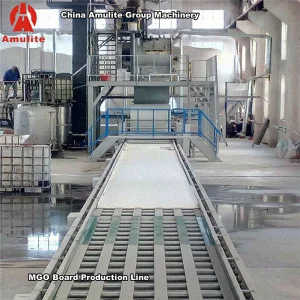
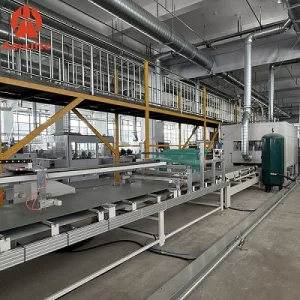
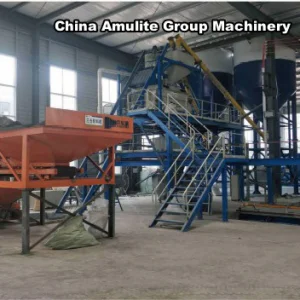
Consult with China Amulite Group’s senior process engineering team today. Receive a custom technical feasibility proposal, equipment layout drawing, and detailed ROI estimation tailored to your local raw material parameters.