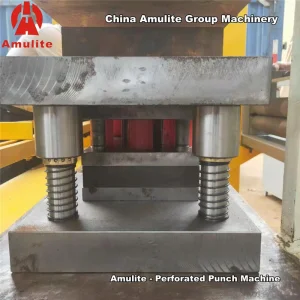
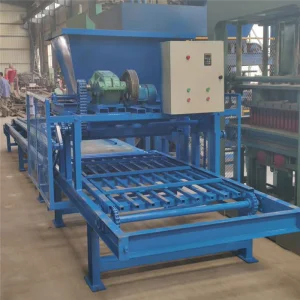
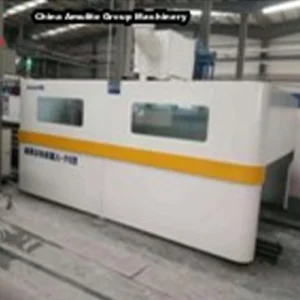
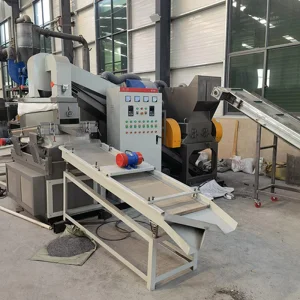
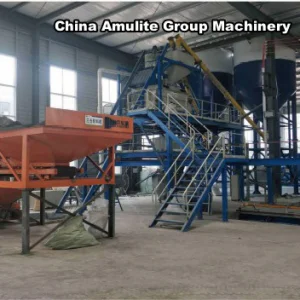
Explore our core engineering equipment for EPS sandwich panels, fiber cement boards, XPS insulation, and automated processing lines.
A comprehensively researched technical guide for global industrial buyers, EPC contractors, and building material manufacturers seeking automated production lines.
The global construction ecosystem is undergoing a fundamental structural transition toward rapid prefabrication, modular building systems, and strict carbon-reduction mandates. At the forefront of this industrial shift is the widespread adoption of EPS (Expanded Polystyrene) Sandwich Cement Wall Panels. As modern architecture demands building components that deliver high strength-to-weight ratios, exceptional thermal insulation (low thermal conductivity), superior acoustic attenuation, and certified fire resistance, commercial demand for high-capacity, automated EPS wall panel machinery has surged globally.
China Amulite Group, backed by over a decade of dedicated chemical process engineering, heavy structural machinery manufacturing, and global industrial commissioning, has established itself as an authoritative leader in OEM EPS panel production technology. This technical whitepaper explores the engineering breakthroughs, raw material matrices, automated production workflows, procurement considerations, and localized compliance standards governing modern EPS wall panel manufacturing machinery.
Traditional wet-construction methods using heavy fired clay bricks or uninsulated concrete blockwork are increasingly restricted by global environmental regulations, labor cost escalations, and extended construction timelines. EPS sandwich cement wall panels—comprising fiber cement or calcium silicate surface boards encapsulating a lightweight composite core of expandable polystyrene beads, Portland cement, fly ash, sand, and specialized chemical foaming agents—represent the pinnacle of modern wall partition engineering.
EPS cement panels offer an extremely low U-value (thermal transmittance), reducing heating and cooling energy consumption in residential and commercial structural frameworks by up to 35% compared to conventional brick walls.
Weighing only 45–65 kg/m² (for a standard 90mm panel), these lightweight composite panels reduce structural dead-load requirements for high-rise steel and concrete frames, lowering foundation engineering costs.
Featuring precision tongue-and-groove joint profiles, EPS sandwich panels install up to 8 times faster than traditional blockwork. No wet plastering is required, enabling immediate surface painting or wallpapering.
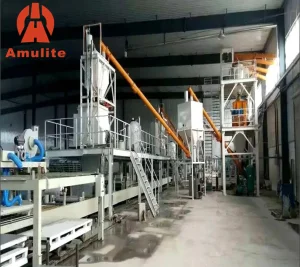
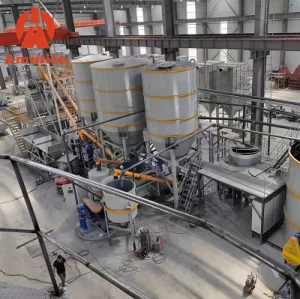
Operating a high-yield EPS panel factory requires complete integration between physical mechanical equipment, precise chemical batching, and automated PLC control loops. Amulite Group’s OEM EPS production plants are built around a modular continuous or vertical mold car framework, optimized for zero-defect slurry pouring, high structural stability, and uniform curing density.
Technical Information Gain: Unlike basic manual mold systems, Amulite's automated EPS wall panel machinery integrates dynamic pressure-sensing core slurry injection with centralized pneumatic mold lockups, preventing board thickness variances and eliminating core-skin delamination risks during curing.
Computerized loss-in-weight batching scales for cement, fly ash, silica sand, and chemical additives. High-accuracy pneumatic conveying ensures zero dust contamination and exact formulation consistency.
Primary and secondary steam pre-expansion machinery expands raw polystyrene beads to targeted bulk densities (8–15 kg/m³) with uniform cell structure and controlled moisture levels.
Custom-engineered twin-shaft planetary mixing vessels ensure homogenous dispersion of cementitious matrix, pre-expanded EPS beads, water, and foaming stabilizers without crushing the delicate EPS cells.
Heavy-duty steel vertical mold cars equipped with high-accuracy side baffles, tongue-and-groove formers, and hydraulic closing mechanisms capable of producing 40–80 panels per mold cycle.
Temperature and humidity-controlled curing rooms accelerate hydration kinetics, ensuring panels achieve early green strength for safe demolding within 3–4 hours.
Robotic mechanical arms extract finished panels, perform automated edge trimming and dimensional verification, stack them on shipping pallets, and stretch-wrap them for global transit.
A critical challenge faced by international buyers purchasing machinery overseas is raw material incompatibility. Machinery must be engineered to handle variations in local cement grades (OPC 42.5 vs 52.5), local sand silting indexes, fly ash carbon content, and water hardness. China Amulite Group resolves this through pre-project chemical analysis and custom formulation engineering.
Our process engineering team tests local raw material samples in our dedicated material laboratory before finalizing machine specs. By adjusting shear mixing RPMs, steam injection rates during mixing, and air-entrainment admixture ratios, we guarantee that the plant achieves optimum compressive strength (>3.5 MPa for non-load-bearing, >5.0 MPa for load-bearing applications) while maintaining low board density (600–750 kg/m³).
When evaluating an OEM EPS sandwich wall panel machine investment, global procurement directors and enterprise project developers focus on three core metrics: Capital Expenditure Efficiency (CAPEX), Operational Efficiency (OPEX), and Payback Duration.
Below is a comparative breakdown showing how Amulite’s automated EPS wall panel machinery optimizes operational returns compared to semi-automated legacy systems:
| Metric Parameter | Amulite Fully Automated Line | Conventional Semi-Manual Line |
|---|---|---|
| Shift Labor Requirement | 6–8 Operators | 18–25 Workers |
| Daily Yield (8-Hour Shift) | 1,500 – 3,000 m² | 400 – 800 m² |
| Material Scrap Rate | < 0.8% (Recycled in-line) | 4.5% – 7.0% |
| Thickness Variance | ± 0.5 mm | ± 2.5 mm |
| Estimated ROI Payback Period | 8 – 14 Months | 20 – 28 Months |
Investing in large-scale industrial machinery demands dependable after-sales technical backing, strict international quality compliance, and rapid spare parts delivery. China Amulite Group operates under ISO 9001:2015 Quality Management and ISO 14001 Environmental Management certifications. All electrical architectures incorporate premium components from world-class suppliers such as Siemens PLC controllers, Schneider electric switches, AirTAC pneumatics, and SEW Eurodrive gear motors.
Every line is built to European CE electrical safety, machinery directive, and pressure vessel manufacturing standards, ensuring smooth regulatory approvals in EU, Middle East, and American markets.
Amulite dispatches senior mechanical and electrical field engineers to customer factory sites globally for site foundation audit, installation management, wiring integration, and live trial runs.
Our modern control cabinets feature secure IoT gateway modules allowing Amulite software specialists in China to perform remote PLC diagnostic checks, system updates, and troubleshooting anywhere in the world.
Looking forward to the next decade of building material engineering, Amulite Group is actively developing ultra-efficient green manufacturing technologies. Key innovation tracks include:
Detailed technical answers provided by China Amulite Group's senior mechanical and process engineering department.
Amulite EPS sandwich cement wall panel production lines are custom-engineered from standard capacities of 100,000 square meters per year up to fully automated continuous manufacturing complexes reaching 2,000,000+ square meters per year. Annual throughput is determined by the number of vertical mold cars operating in rotation, the degree of automated batching, and local ambient curing cycle speeds.
Core-skin delamination is prevented through dual engineering mechanisms. First, during raw material mixing, a specialized polymer interface bonding agent is incorporated into the cementitious slurry. Second, the hydraulic vertical mold cars utilize constant lateral pressure clamping while curing. This guarantees complete chemical bonding and mechanical keying between the fiber cement/calcium silicate face sheets and the expanding core matrix.
The system is extremely versatile. In addition to standard Ordinary Portland Cement (OPC) and pre-expanded EPS beads, the core formulation can incorporate up to 40% pulverized fuel fly ash (PFA), crushed silica quarry dust, ground granulated blast-furnace slag (GGBS), or expanded perlite. Amulite provides tailored formulation recipes based on the lowest-cost industrial minerals available in your local geography.
A standard 500,000 m²/year automated plant typically requires an installed electrical load of approximately 120–180 kW (380V/50Hz 3-Phase standard), an operational steam boiler delivering 1.0 to 1.5 tons/hour at 0.8 MPa (for EPS bead pre-expansion and curing tunnel heating), and a compressed air system delivering 1.2 m³/min at 0.8 MPa pressure.
Machinery fabrication takes 60–90 days following layout drawing sign-off. Shipping varies by destination port (typically 20–45 days). Once equipment arrives at your facility, our resident field installation engineers complete mechanical setup, electrical wiring, PLC integration, raw material testing, and full workforce training within 30 to 45 days.
Explore our extended machinery catalogue including AAC block lines, perlite expanders, tile backer systems, and recycling equipment.