The global interior construction landscape is undergoing an unprecedented structural transition toward high-efficiency, lightweight, and carbon-optimized wallboard materials. As urban housing demands surge across Asia, the Middle East, Latin America, and Eastern Europe, commercial building developers and industrial gypsum plasterboard manufacturers face a dual challenge: maximizing volumetric production output while drastically curtailing thermal and electrical energy overheads.
Gypsum board (drywall)—composed of a hydrated calcium sulphate dihydrate core ($\text{CaSO}_4 \cdot 2\text{H}_2\text{O}$) encased between high-tensile paper liners—serves as the cornerstone for modern interior partitions, acoustic ceilings, and fire-rated wall assemblies. However, achieving continuous, defect-free production at linear speeds exceeding 80 to 120 meters per minute requires specialized heavy engineering, precise raw material dosing, automated multi-deck drying kinetics, and intelligent PLC-driven SCADA governance.
This whitepaper provides an exhaustive technical analysis of turnkey OEM gypsum board machinery fabrication, continuous slurry formulation dynamics, synthetic Flue Gas Desulfurization (FGD) gypsum utilization, localized international compliance frameworks, and AI-assisted quality control architectures tailored for prospective plant owners, industrial project managers, and building material conglomerates worldwide.
Modular line architectures accommodating annual production capacities from 2 million m² up to 60 million m², tailored to local regional market demand curves.
Advanced raw material pretreatments capable of processing 100% industrial FGD gypsum and phosphogypsum, reducing raw material procurement expenditures.
Multi-stage direct/indirect thermal heat exchange technology engineered to minimize natural gas, heavy fuel oil, or steam consumption per square meter.
A modern OEM gypsum wallboard plant operates as a continuous, automated production line where micro-variations in moisture, temperature, or chemical additives directly impact board flexural strength, edge integrity, and drying efficiency. Below is the technical breakdown of the core unit operations within our turnkey plant manufacturing ecosystem:
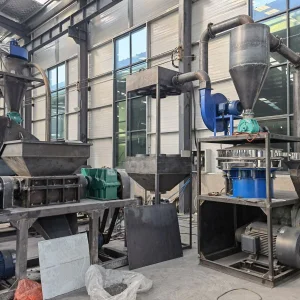
Natural gypsum rock ($\text{CaSO}_4 \cdot 2\text{H}_2\text{O}$) or synthetic FGD gypsum undergoes primary crushing, drying, and fine pulverized grinding down to 80-120 mesh. The ground material enters a high-efficiency fluid-bed calciner or ebullience kiln operating at controlled temperatures ($150^\circ\text{C} - 170^\circ\text{C}$), driving off 1.5 molecules of crystal water to form Stucco (Hemihydrate, $\text{CaSO}_4 \cdot 0.5\text{H}_2\text{O}$):
Our OEM calciners feature automated temperature feedback loops to guarantee calcination consistency, preventing uncalcined dihydrate residues or over-calcined anhydrite ($\text{CaSO}_4 \text{ III}$) which degrade final board binding properties.
Stucco powder is metered via loss-in-weight screw feeders into a specialized continuous pin mixer. Simultaneously, precise micro-dosages of dry and liquid additives are injected:
The homogeneous aerated slurry is distributed evenly onto the continuous bottom face paper liner. Edge-forming wheels crease and fold the paper margins (Square Edge, Tapered Edge, or Beveled Edge). The top backing paper is applied, passing through a high-precision forming station with adjustable vibrating plates to guarantee uniform board thickness (ranging from 6.0 mm to 15.0 mm).
The endless wet plaster ribbon travels down a 150-meter to 300-meter setting belt belt conveyor, providing 4 to 6 minutes of dwell time required for full re-crystallization into interlocking dihydrate needle structures. At the end of the setting line, a high-speed rotary guillotine cutter cuts the continuous ribbon into exact target lengths (standard 2400mm, 3000mm, or custom OEM dimensions) with millimeter precision.
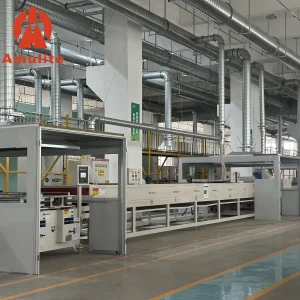
Wet boards containing approximately 35% to 40% free moisture are transferred via dynamic roller tables and multi-tier tippers into a 6 to 12-deck continuous drying kiln. The dryer features distinct thermal zones:
| Performance Specification | Standard OEM Configuration | High-Speed Heavy Industrial Line | Green FGD Specialized Line |
|---|---|---|---|
| Annual Line Capacity | 5,000,000 – 15,000,000 m² | 20,000,000 – 60,000,000 m² | 10,000,000 – 30,000,000 m² |
| Line Speed Range | 15 – 35 m/min | 40 – 120 m/min | 25 – 65 m/min |
| Board Thickness Range | 6.0 mm – 15.0 mm (±0.3 mm) | 6.0 mm – 19.0 mm (±0.2 mm) | 8.0 mm – 16.0 mm (±0.25 mm) |
| Board Density Range | 650 – 800 kg/m³ | 550 – 720 kg/m³ (Lightweight) | 600 – 750 kg/m³ |
| Thermal Fuel Source | Natural Gas / Coal / Diesel | Natural Gas / Direct Fired Burner | Waste Steam / Heat Exchanger / Gas |
| Dryer Configuration | 6 to 8 Decks | 10 to 14 Decks (Double-Pitch) | 8 to 12 Decks |
| Automation Architecture | Siemens S7-1500 / WinCC PLC | Siemens Distributed Control + SCADA | Schneider / Allen-Bradley PLC Integration |
As standard machinery suppliers compete on base hardware, China Amulite Group delivers crucial Information Gain by embedding real-time predictive analytics, automated slurry viscosity tracking, and closed-loop thermal recuperation systems directly into every custom OEM plant project.
Exhaust air exiting the final drying zones ($110^\circ\text{C} - 130^\circ\text{C}$) passes through air-to-air thermal exchangers to preheat incoming fresh combustion air and water supplies. This innovation drops plant gas consumption by up to 28% compared to traditional open-loop systems.
Inline ultrasound sensors continuous monitor wet core viscosity before the forming plate. The PLC automatically adjusts water-reducing chemical dosing in real-time, eliminating slurry density drift caused by raw gypsum raw material humidity changes.
Investing in a high-capacity OEM gypsum board plant requires strict alignment with localized building codes, raw material chemistry variations, electrical safety protocols, and environmental emissions standards. China Amulite Group provides full turnkey execution—from initial site geology assessment to localized product compliance certification.
Our engineered production lines produce finished gypsum wallboards certified under international standards, ensuring immediate market entry for regional distributors:
Engineered to withstand extreme ambient temperatures ($50^\circ\text{C}+$), utilizing specialized cooling jackets for hydraulic systems and synthetic FGD/Desulfurization gypsum formulations.
Customized for high-humidity environments, integrating specialized anti-fungal and moisture-resistant silicone chemical injection units for Type H board manufacturing.
Equipped with dual-fuel combustion chambers (Natural Gas + Heavy Oil) and thick thermal insulation shells designed for cold climate operational efficiency.
Modern building construction demands versatile drywall wallboard products optimized for specific architectural micro-environments. An Amulite OEM Gypsum Board Line can be rapidly re-configured via automated recipe management to manufacture diverse board types:
Widely specified for residential ceilings and dry partition walls. Optimized for lightweight composition ($600 - 680 \text{ kg/m}^3$), crisp edge cutting, and rapid screw driving without paper tearing.
Formulated with non-combustible micro-glass fibers ($0.2\% - 0.5\%$ weight concentration) and unexpanded vermiculite. Core integrity is maintained under direct flame exposure exceeding 2 hours in elevator shafts and commercial stairwells.
Incorporates hydrophobic wax emulsion and silicone oil additives into the core, paired with green moisture-repellent paper liners. Engineered for bathrooms, kitchens, and tropical interior environments with total water absorption < 5%.
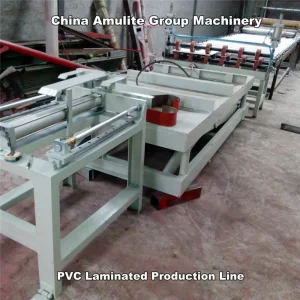
Gypsum boards trimmed down to $600\times600\text{mm}$ tiles, integrated with an inline PVC film laminating machine and aluminum foil backing layer for heavy-duty acoustic suspended ceiling grids.
As environmental regulations tighten globally, the gypsum machinery manufacturing sector is transitioning toward carbon-neutral operation models, ultra-lightweight density target specs, and fully automated unmanned production bays. Amulite's ongoing R&D engineering roadmap focuses on three technological pillars:
Transitioning from fossil natural gas combustion to modular hydrogen-blend and electric-assisted thermal drying chambers to eliminate direct carbon emissions on site.
Deploying multi-angle high-resolution vision systems to detect sub-millimeter surface pinholes, edge chips, or paper delamination at line speeds up to 120 m/min.
Advanced condensation capture units mounted atop dryer exhaust stacks, recovering 95% of evaporated process water for continuous recycling back into slurry mixing vats.
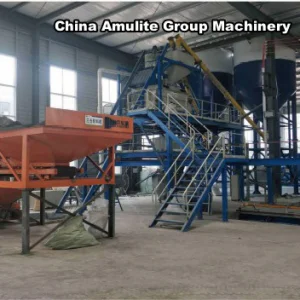
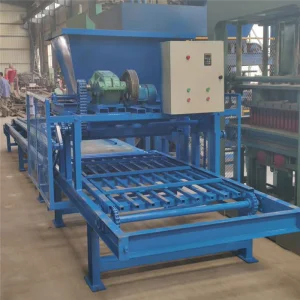
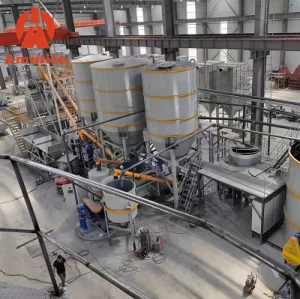
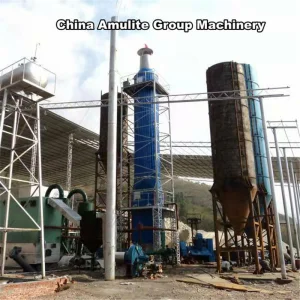
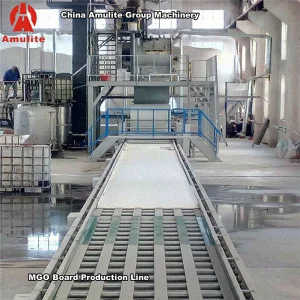
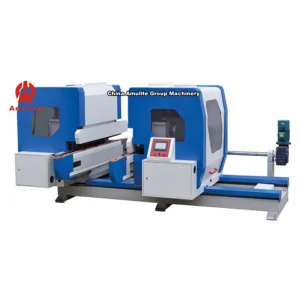
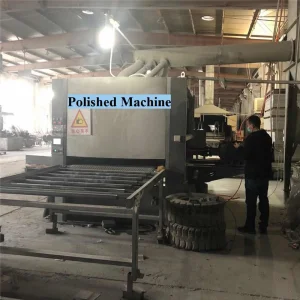
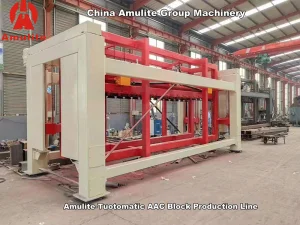
Whether you are upgrading an existing plasterboard facility or building a multi-million square meter greenfield plant, China Amulite Group delivers turnkey engineering, custom fabrication, and lifetime process support.
Request Turnkey Project Proposal & Technical Specifications