Industrial machinery engineered to precision specifications for building material manufacturing plants across Portugal and Europe.
Analyzing supply chain dynamics, decarbonization mandates, and regional manufacturing expansion across Southern Europe.
The worldwide industrial market for gypsum powder (calcium sulfate hemihydrate, $\text{CaSO}_4 \cdot 0.5\text{H}_2\text{O}$) is undergoing a structural paradigm shift. Driven by urban expansion, modern drywall installation techniques, and stringent building energy efficiency codes (such as the European Energy Performance of Buildings Directive - EPBD), the demand for high-strength, consistent-setting plaster products has reached unprecedented peaks. Historically dependent on raw mineral rock extraction, modern manufacturing facilities are increasingly transitioning toward hybrid feedstocks—integrating high-purity natural gypsum rock with flue-gas desulfurization (FGD) gypsum byproduct and recycled post-construction drywall materials.
Global architectural trends favor lightweight, dry construction methods over traditional wet masonry. This shift elevates gypsum plaster from a basic finishing material to an engineered structural element. Consequently, production facilities are evaluated not merely on volume, but on particle size distribution (PSD), phase composition control (calibrating ratio of $\beta$-hemihydrate to soluble anhydrite), thermal energy efficiency, and operational carbon footprint.
As the primary urban center and logistics corridor of Portugal’s southern Algarve region, Faro presents a strategic micro-environment for building material processing and export distribution. Situated near crucial transportation routes—including the A22 highway network, direct rail connections to Lisbon and Porto, and maritime access via the Port of Faro and nearby deep-water terminal infrastructure at Sines—Faro is uniquely positioned as a regional hub for localized processing and Mediterranean-Atlantic trade.
The construction landscape in Southern Portugal and neighboring Andalusia (Spain) is defined by two key drivers:
Establishing an advanced Gypsum Powder Production Line within the Faro supply ecosystem provides manufacturers with immediate proximity to growing domestic demand while leveraging Atlantic maritime logistics for export to Western Africa, Northern Europe, and the Americas.
A rigorous step-by-step technological breakdown of raw material transformation, calcination thermodynamics, and particle sizing.
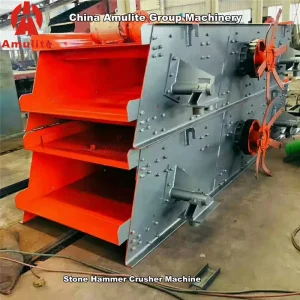
Primary jaw crushing & secondary hammer milling reducing lump rock (<500mm) down to uniform <25mm feed size.
Vertical Roller Mill / Raymond Mill with dynamic air classifier ensuring controlled fineness (100 to 325 mesh).
Thermal conversion at 150°C–170°C, stripping crystal water to form stable $\beta$-stucco plaster.
Silo homogenization allowing phase redistribution, reducing water demand and stabilizing initial setting time.
Additive dosing, high-speed blending, and automated valve-bag packaging or bulk loading.
The production of high-grade construction plaster relies on controlled endothermic dehydration of dihydrate gypsum rock ($\text{CaSO}_4 \cdot 2\text{H}_2\text{O}$). Under precise thermal regulation, three-quarters of the chemically bound water is expelled according to the following stoichiometric reaction:
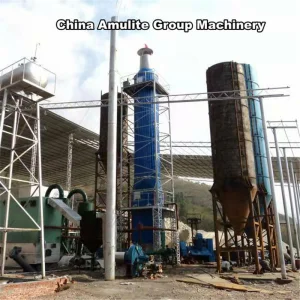
If heating is non-uniform or exceeds target kinetic thresholds (>200°C), undesirable over-calcination occurs, creating dead-burnt anhydrite ($\text{CaSO}_4$ III or II) which exhibits negligible hydration activity. Conversely, under-calcination leaves unreacted dihydrate, causing erratic setting behavior. China Amulite Group’s engineered Fluidized Bed Ebullience Furnace addresses this through uniform heat transfer via hot steam coil arrays or direct thermal fluid tubes immersed directly within the fluidized powder column. Fluidizing combustion air ensures every particle undergoes identical residence time and thermal exposure.
| Parameter / Feature | Amulite Fluidized Bed Calciner | Traditional Rotary Kiln | Direct-Fired Flash Furnace |
|---|---|---|---|
| Thermal Efficiency | 85% - 90% (Ultra High) | 55% - 65% (Moderate) | 70% - 75% (Medium) |
| Phase Purity ($\beta$-Stucco) | > 92% Consistency | 75% - 85% (Variable) | 80% - 88% (Moderate) |
| Specific Power Consumption | 18 - 22 kWh / Ton | 28 - 35 kWh / Ton | 24 - 30 kWh / Ton |
| Footprint Requirement | Compact (Vertical Stack) | Extensive Horiz. Area | Medium Footprint |
| Dust Collection Efficiency | 99.9% (Integrated Baghouse) | 95% - 98% (External Cyclone) | 99.0% (Pulse Jet) |
Integrating SCADA control, NIR moisture sensing, and predictive thermal loops for zero-defect operational control.
Siemens S7-1500 PLC paired with centralized SCADA software provides real-time tracking of temperature gradients, bed pressure differential, and screw feeder velocity across all plant modules.
Automated optical dispersion sensors continuously inspect ground gypsum powder prior to calcination, dynamically adjusting separator rotor speed to guarantee precise mesh consistency.
Algorithmic gas-burner modulation balances heat input against raw material free-moisture fluctuations, ensuring zero fuel waste during feed composition variations.
Adapting machinery parameter configurations to produce diverse industrial and building plaster grades.
A turnkey Gypsum Powder Production Line supplied by China Amulite Group is not a static installation; it is an adaptable chemical processing platform capable of outputting distinct plaster grades tailored to specific market demands in Faro and international territories:
Optimized for continuous drywall manufacturing lines. Features rapid hydration kinetics, low water-to-plaster ratio (WPR), and uniform crystal interlocking for high core strength.
Formulated with cellulose ethers and air-entraining agents. Engineered for continuous spray-application on masonry walls, providing long open times and smooth finishing.
Based on $\alpha$-hemihydrate or synthetic anhydrite blends. Creates seamless, crack-free sub-floors with high thermal conductivity, ideal for radiant underfloor heating installations.
Super-fine plaster (325 mesh) with strict bulk density limits and high absorption capacity, designed for sanitaryware, fine pottery, and industrial precision casting moulds.
Pioneering sustainable manufacturing technologies for compliance with European environmental standards.
As industrial regulations tighten across Europe and globally, the production of gypsum powder must evolve toward zero net carbon emissions and zero solid waste. China Amulite Group’s R&D division focuses on three major technological transitions:
In-depth engineering answers provided directly by China Amulite Group’s Senior Process Project Team.
We engineer custom plant solutions ranging from 30,000 metric tons per year for specialized regional facilities up to 500,000 metric tons per year for large-scale industrial plaster and drywall board manufacturing hubs. System modularity allows for phased expansion to align with market demand.
Yes. Our feeding, drying, and calcination systems are dual-engineered. For natural rock, we incorporate primary crushing and Raymond/Vertical Roller grinding. For synthetic FGD gypsum (which presents high free moisture up to 12%), we integrate a specialized flash drying tube ahead of the fluidized calciner to prevent agglomeration and guarantee uniform fluidization.
Under standard operational parameters with input rock purity $\ge 85\%$, electrical power consumption averages 18 to 22 kWh per ton, and thermal energy consumption averages $250,000$ to $300,000 \text{ kcal}$ per ton ($35-40 \text{ kg standard coal equivalent}$). Heat exchanger recovery loops allow pre-heating of incoming feed material using exhaust gas streams.
Every project includes full engineering documentation compliant with EU directives (CE certification, ATEX explosion-proof compliance for dust collection, and ISO 9001 quality management). We dispatch resident mechanical, electrical, and commissioning engineers to manage civil checking, equipment erection, PLC integration, and operator training on site in Faro until performance targets are verified.
Manufacturing and shop pre-assembly require 90 to 120 days. Ocean freight to the Port of Faro or Port of Sines typically takes 25 to 35 days. Mechanical installation requires 45 to 60 days, followed by 20 days of cold/hot commissioning and formulation optimization.
Fineness is regulated via a variable-frequency drive (VFD) controlling the dynamic separator rotor speed in the grinding mill. Operators can adjust target output from 100 mesh (>98% passing) up to 325 mesh directly through the SCADA touchscreen interface without stopping production.
We provide a comprehensive 12-month mechanical and electrical warranty from the date of final commissioning. After-sales support includes 24/7 remote PLC diagnostic connectivity, fast-track dispatch of wear parts (grinding rollers, ring dies, valve bags, filter sleeves), and annual on-site maintenance audits by our field engineering team.
You can contact our engineering team via the inquiry button below. Clients can send a 10 kg sample of raw gypsum rock or FGD cake to our central materials laboratory for XRD phase analysis, moisture testing, thermal gravimetric analysis (TGA), and tailored plant sizing.
Explore our complete machinery matrix for non-metallic mineral processing and structural board manufacturing.

Partner with China Amulite Group for full engineering design, equipment fabrication, local layout optimization, and lifetime field technical support. Get a detailed ROI proposal within 24 hours.