How to Choose the Best Polystyrene Panel Making Machine

Time:2026-09-30 Author:Sienna
0%

Choosing the right Polystyrene Panel Making Machine requires more than comparing prices or advertised output. It demands evidence from real production conditions.

Grand View Research estimates that the global expanded polystyrene market reached approximately USD 11.7 billion in 2023. The report also projects steady growth through 2030. PlasticsEurope’s Plastics—the Fast Facts 2023 reports global plastics production at 400.3 million tonnes in 2022. These figures suggest continued demand, but they do not guarantee profitability for every factory.

A practical evaluation should examine pre-expansion stability, steam consumption, mold accuracy, panel thickness, cooling time, and automation quality. Ask suppliers for tested density ranges, cycle records, maintenance schedules, and energy data. A machine producing 1,000 panels daily may still perform poorly if thickness varies by several millimeters. Small defects become expensive during installation.

Dr. Patrick Thomas, former Covestro chief executive, has emphasized, “The plastics industry must learn to do more with less.” That principle applies directly to equipment selection. Lower energy use, reduced scrap, and repeatable molding can matter more than impressive headline capacity.

Look closely at the details. Inspect welds, valves, sensors, and control screens. Request a factory trial using your intended bead grade. Do not trust every brochure number. Some published capacity figures assume ideal materials, skilled operators, and uninterrupted steam supply. Real production is less perfect. A careful buyer allows room for that reality.
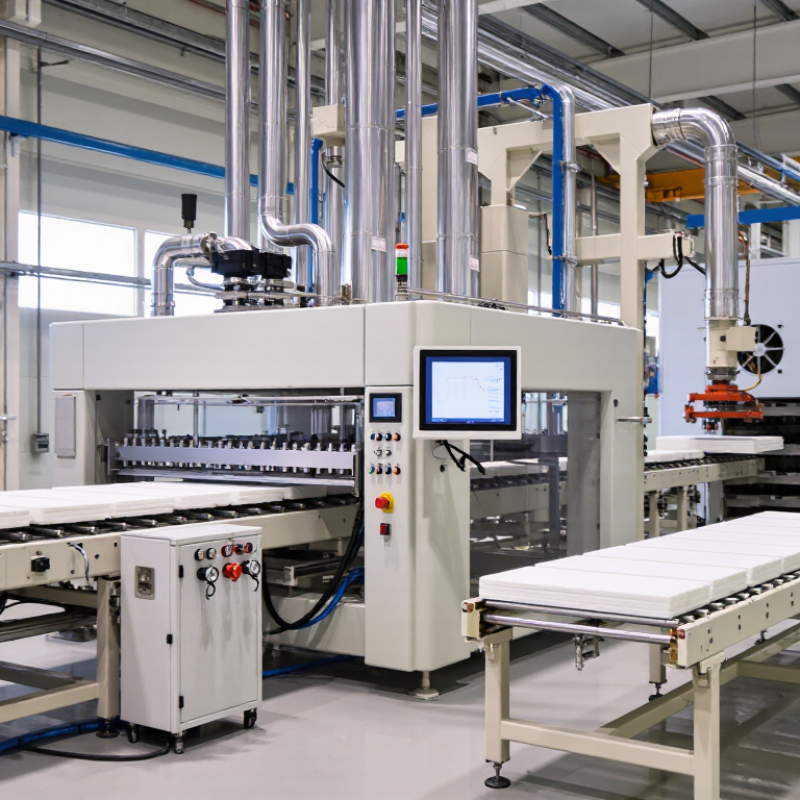
How to Choose the Best Polystyrene Panel Making Machine

Define Panel Type: EPS Densities Commonly Range from 10–35 kg/m³

Choosing a polystyrene panel making machine starts with the panel’s required EPS density. Common densities range from 10 to 35 kg/m³. This range is wide. A lightweight insulation panel may need 10–15 kg/m³, while packaging or structural applications often require 20–35 kg/m³. Lower densities reduce material use, but they can weaken edges and increase dimensional variation. Higher densities improve strength and surface hardness, yet they demand better steam control and longer molding cycles.

Check the machine’s practical density range, not only its brochure specification. During trial production, measure the finished panel after conditioning, not immediately after ejection. Steam pressure, bead pre-expansion, mold temperature, and cooling time can shift the final result. A machine designed for 15 kg/m³ may struggle to produce consistent 30 kg/m³ panels. That assumption is risky. Ask for test samples using your actual bead size and target thickness. Inspect cut edges, corner sharpness, weight tolerance, and bonding surfaces. Small density differences matter.

Panel geometry also affects machine selection. Thick panels need uniform steam penetration, while narrow grooves require accurate mold filling. Automatic feeding can improve repeatability, but poor calibration still creates uneven zones. I would record each trial’s bead age, moisture, steam pressure, and cycle time. Some production teams skip this step. Later, they blame the machine for unstable density. A simple production log often reveals the real problem.

Match Machine Capacity to Output Targets: Compare Blocks per Hour and Panel Size

How to Choose the Best Polystyrene Panel Making Machine

Machine capacity should match your real output target, not only the number shown in a brochure. Grand View Research estimates that the global expanded polystyrene market will continue growing through 2030, increasing pressure on panel producers to control delivery times and waste. Start with daily demand. If you need 600 finished panels during an eight-hour shift, your target is 75 good panels per hour. With an 8% rejection allowance, the machine should deliver about 82 panels per hour.

Check what “blocks per hour” actually means. Some suppliers count molding cycles, while others count completed blocks. A large block may produce many 1,200 × 600 mm panels, but cutting time, cooling, density, and thickness changes can reduce the final rate. Ask for tested figures using your required panel size and density. PlasticsEurope reported global plastics production at about 400 million tonnes in 2022, showing the scale of the industry, but scale does not guarantee suitable equipment. A spreadsheet can still lie.

Tips: Measure good panels per shift, not theoretical cycles. Request a trial using your raw material. Record cycle time, cooling time, cutting speed, and reject percentage. Leave practical capacity below the advertised maximum. Do not guess. A smaller machine with stable output may outperform a faster machine that creates uneven edges, oversized panels, or frequent stoppages. Recheck the calculation after one production week.

Match Machine Capacity to Output Targets

Compare theoretical panel output at different block-processing rates and panel thicknesses.

Assumption: one 2,000 × 1,000 × 1,000 mm EPS block is cut into 1,000 × 500 mm panels. The chart estimates yield without kerf, trimming, setup, or handling losses; actual production will be lower.

Evaluate Thermal Performance: Target EPS Conductivity of 0.030–0.040 W/m·K

When choosing a polystyrene panel making machine, evaluate whether it can produce stable EPS panels with thermal conductivity around 0.030–0.040 W/m·K. This range is a useful target, not a guarantee of performance. Density, bead fusion, moisture, and test temperature can all affect the measured result. A panel may look smooth but still contain unevenly fused areas.

Ask for test data from panels made under conditions similar to your planned production. Check that the measurement method and sample thickness are clearly stated. Compare samples from different runs, not just one ideal panel. In practice, steady steam control and even filling can help reduce variation. Still, machine settings are only part of the picture. Raw material and operator adjustments matter too.

Tips: Request a small production trial. Measure more than one sample, and record density alongside conductivity. Keep the test conditions consistent. A single low reading can be misleading. If results vary, inspect panel edges and cut sections for gaps or weak fusion before choosing the machine.

Verify Cutting Accuracy, Steam Pressure, and EN 13163/ASTM C578 Compliance

When choosing a polystyrene panel making machine, test cutting accuracy with the foam grade and panel thickness you expect to produce. Measure several points along each cut, not just one corner. Check length, width, squareness, and edge finish against your required tolerances. A hot wire can leave a smooth edge but drift when feed speed or wire temperature changes. Run repeated cuts. Watch for bowed faces, uneven thickness, and rough edges. I would not trust a single clean sample; that is an easy mistake to make. Keep records of settings and measurements so operators can repeat a good result.

Steam pressure needs equal attention. Ask for the machine’s recommended operating range, then verify that gauges are calibrated and pressure stays steady during a full production cycle. Too much variation can affect bead expansion, fusion, and panel consistency. The right setting depends on material, mold, and process, so avoid choosing equipment from a pressure figure alone. Also confirm that the manufacturer can explain how finished panels are assessed against EN 13163 or ASTM C578. These standards address product properties, not a machine’s cutting precision by themselves. Request test reports for relevant properties, such as dimensions and thermal performance, and check that the stated grade matches your intended use. Paperwork matters, but real sample panels deserve a close look, too.

Calculate Total Cost: Energy, Molds, Labor, and 5–10-Year Maintenance

Choosing a polystyrene panel making machine requires more than comparing purchase prices. Build a five-to-ten-year cost model before visiting suppliers. Record rated power, hourly output, operating hours, electricity price, and expected production days. A 30 kW machine running 2,000 hours yearly uses 60,000 kWh. At $0.12 per kWh, annual electricity costs reach $7,200.

Molds can change the calculation quickly. List each panel size, mold price, replacement interval, and setup time. Include cooling components, cutting tools, and spare heating elements. Labor also needs a realistic estimate. One operator may manage the line, but loading, quality checks, cleaning, and packing still require time. In a plant trial, a ten-minute mold change caused more lost output than expected. That detail is easy to miss.

Maintenance should be forecast by year, not guessed as one percentage. Ask for service schedules, lubrication points, replacement parts, and technical support response times. Budget routine maintenance for years one through five, then increase the allowance for aging heaters, sensors, pumps, and control systems. Compare downtime costs with preventive maintenance costs. Cheap parts are not always cheaper. I would also test a sample mold before purchasing. My first estimate might still be wrong, especially when energy demand changes during winter production. Keep a contingency reserve of 10–15 percent, and verify every supplier figure against measured factory data.

How to Choose the Best Polystyrene Panel Making Machine - Calculate Total Cost: Energy, Molds, Labor, and 5–10-Year Maintenance

Evaluation Item Compact Manual / Semi-Manual Standard Semi-Automatic High-Output Automatic
Recommended application Small workshops and regional orders Regular commercial production Large-volume continuous production
Estimated useful service life 10 years 10 years 10 years
Typical rated output 25,000 m²/year 50,000 m²/year 100,000 m²/year
Estimated purchase price US$38,000 US$72,000 US$145,000
Average electricity use 0.80 kWh/m² 0.65 kWh/m² 0.50 kWh/m²
Electricity price used in calculation US$0.12/kWh US$0.12/kWh US$0.12/kWh
Annual electricity cost US$2,400 US$3,900 US$6,000
Operators required per shift 2.0 1.5 1.0
Loaded labor rate used US$22/hour US$22/hour US$22/hour
Annual labor cost US$88,000 US$66,000 US$44,000
Initial mold-set cost US$12,000 US$18,000 US$30,000
Expected mold replacement cycle Every 3 years Every 4 years Every 5 years
Estimated 10-year mold cost US$48,000 US$54,000 US$60,000
Estimated annual maintenance rate 4% of purchase price 5% of purchase price 6% of purchase price
Estimated 10-year maintenance cost US$15,200 US$36,000 US$87,000
10-year energy cost US$24,000 US$39,000 US$60,000
10-year labor cost US$880,000 US$660,000 US$440,000
Estimated 10-year total cost of ownership US$1,005,200 US$861,000 US$792,000
10-year cost per produced m² US$4.02/m² US$1.72/m² US$0.79/m²
Best choice when Capital budget is the main constraint Balanced cost, flexibility, and capacity are required Demand is high enough to use most rated capacity
Calculation assumptions: Costs are planning estimates in U.S. dollars. Annual production assumes 2,000 operating hours and 100% utilization of the stated planning volume. Labor includes wages, payroll burden, and basic benefits. The 10-year total includes purchase price, electricity, labor, mold replacement, and routine maintenance, but excludes raw materials, rent, financing, taxes, shipping, installation, utilities other than electricity, downtime, and product-quality losses.

FAQS

How should I calculate the machine capacity I need?

Divide your daily target by shift hours. For 600 good panels in eight hours, target 75 panels per hour. Add room for rejects; an 8% allowance means about 82 panels per hour.

What does “blocks per hour” mean?

It may describe molding cycles, not finished blocks. Ask the supplier to define the figure and demonstrate output using your panel size and density.

Why can actual output be lower than the advertised rate?

Cooling, cutting, thickness changes, and rejected panels all reduce finished output. Measure the full process. A spreadsheet can still mislead.

What should a production trial measure?

Use your raw material and record cycle time, cooling time, cutting speed, and reject percentage. Count acceptable panels per shift, not theoretical cycles.

How can I check cutting accuracy?

Measure several points on each panel, including length, width, thickness, and squareness. Inspect edges and faces for roughness, bowing, or uneven thickness.

Is one clean sample enough to prove cutting quality?

No. Run repeated cuts at your expected feed speed and wire temperature. A single sample can hide drift.

What should I check about steam pressure?

Confirm the recommended operating range and check that calibrated gauges show steady pressure during a full cycle. The suitable setting depends on the material and mold.

How do EN 13163 and ASTM C578 relate to machine selection?

They address properties of finished products, not cutting precision alone. Request relevant test reports and inspect sample panels for dimensions and thermal performance. Paperwork helps, but samples matter.

Conclusion

Choosing the right Polystyrene Panel Making Machine begins with clearly defining the required panel type and EPS density, which commonly ranges from 10 to 35 kg/m³. The machine should match your expected production volume, so compare its block output per hour, compatible panel dimensions, and ability to maintain consistent quality. Thermal performance is also essential; a suitable machine should support panels achieving an EPS thermal conductivity of approximately 0.030–0.040 W/m·K.

Before making a decision, verify cutting accuracy, steam pressure control, molding stability, and compatibility with relevant requirements such as EN 13163 or ASTM C578. A complete cost evaluation should include not only the purchase price, but also energy consumption, molds, labor, routine maintenance, and likely repairs over a five- to ten-year period. By balancing product specifications, production targets, performance, compliance, and long-term operating costs, manufacturers can select equipment that delivers reliable efficiency and consistent panel quality.

Sienna

Sienna

Sienna is a skilled marketing professional with a deep expertise in our company’s core products and services. With a passion for innovation and detail, she plays a pivotal role in crafting insightful blog posts that not only highlight the unique features of our offerings but also provide valuable......