Choosing the best Composite Wallboard Production Line is not simply a price comparison. It is an engineering decision shaped by materials, factory space, labor, energy, and market demand.
Dr. Michael F. Ashby, a leading materials-selection authority, has emphasized, “Materials and process selection is a central part of engineering design.” This principle applies directly to wallboard manufacturing. A line must match the board’s core density, panel thickness, surface finish, curing method, and required output. A machine producing 3,000 panels daily may appear attractive, but its capacity means little if your warehouse cannot store finished boards. Small details matter. Observe the mixing chamber. Check the conveyor alignment. Listen for abnormal vibration.
Reliable selection also requires evidence. Request production samples made with your actual cement, fibers, additives, or recycled materials. Examine edge strength, moisture resistance, dimensional stability, and demolding quality. Ask for verified energy data, maintenance schedules, spare-parts availability, and installation support. Speak with existing users, not only sales representatives. Their experience may reveal cleaning delays or difficult control software.
No line is perfect. A cheaper system may create higher labor costs later. A highly automated line may demand better technicians than your factory currently has. We may also overestimate future demand. Therefore, compare total ownership cost over several years, not only the purchase invoice. A careful buyer should leave room for uncertainty, testing, and gradual expansion. The best Composite Wallboard Production Line is the one that consistently produces saleable panels under your real operating conditions.
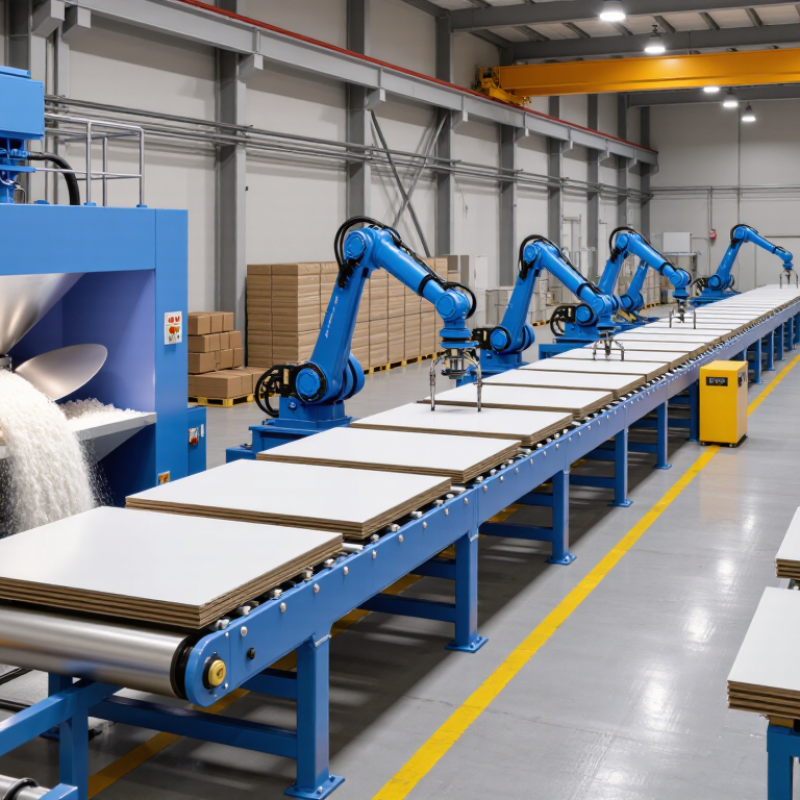
How to Choose the Best Composite Wallboard Production Line?
What Is a Composite Wallboard Production Line?
A composite wallboard production line is an integrated system for manufacturing lightweight building panels. It combines material preparation, mixing, forming, curing, cutting, and stacking. The panel usually contains a cement-based core, insulation material, or reinforcing additives. Its exact structure depends on the required strength, fire performance, moisture resistance, and weight.
In practical factory assessments, I examine the complete process rather than one machine. Accurate batching supports stable density. Even mixing prevents weak areas inside the board. Forming equipment controls panel thickness and surface quality. Curing chambers then provide suitable temperature and humidity. After curing, cutting units create consistent dimensions, while stacking systems reduce handling damage. Small errors can become expensive waste.
A reliable line should match your material formula, production capacity, workshop space, and local building requirements. Check adjustment ranges, cleaning access, spare-part availability, and operator safety features. Energy use also matters, especially during curing. A fast line is not always the best line. I have seen equipment selected for maximum output, while the factory actually needed better flexibility. That decision required rethinking.
Tips: Request trial production with your intended materials. Measure thickness, density, bonding strength, and surface flatness. Ask how the line responds to formula changes. Confirm maintenance procedures before signing any technical agreement. Keep records. They reveal problems early.
A composite wallboard production line combines material batching, mixing, forming, pressing, curing, cutting, and quality inspection to manufacture lightweight panels with a core and one or more facing layers. The most suitable line depends on required output, board dimensions, automation level, available floor space, energy supply, and product consistency.
How to read the chart: These reference capacities show commonly used output levels for an eight-hour production shift. Actual production depends on board thickness, panel size, curing time, material formulation, equipment utilization, and rejected-product rates. When comparing suppliers, confirm guaranteed capacity using the same board specifications and shift conditions.
How to Choose the Best Composite Wallboard Production Line?
Choosing raw materials starts with the building’s actual demands. Cement-based mixes offer strength and familiar processing. Expanded polystyrene improves thermal insulation and reduces panel weight. Rock wool provides stronger fire resistance, but it needs careful handling and consistent bonding. Recycled fillers may reduce costs, yet their moisture content can change the final board quality.
Board type matters just as much. EPS cement sandwich panels suit many lightweight partition walls and exterior applications. Rock wool sandwich panels are better for projects with stricter fire-performance requirements. Fiber-cement boards can deliver a harder surface and better impact resistance. Each option requires a suitable mixing, forming, cutting, and curing system. The line must match panel thickness, density, daily output, and factory space.
Do not choose by price alone. A cheaper mix can look attractive. It may also crack later. During practical evaluations, check raw material uniformity, curing temperature, panel flatness, and edge strength. Ask for test records, not only production claims. Small moisture changes can affect foaming and bonding. This is where many plans become too optimistic. A reliable selection also considers local climate, worker skills, maintenance access, and available testing equipment. Prototype panels should be tested before full-scale investment.
Production capacity should match confirmed orders, not optimistic forecasts. Start with board thickness, width, length, density, and target output per shift. A line rated at 10,000 square meters daily may deliver far less after curing delays, changeovers, maintenance, and rejected panels. Use effective capacity, not the brochure figure.
Measure each process separately. Check mixer volume, dosing accuracy, forming speed, curing time, cutting precision, and stacking efficiency. The slowest stage controls the entire line. Allow practical space for storage between forming and curing. You need room for inspection, too. A small buffer can prevent one stopped machine from halting production.
Equipment configuration must fit the material formula and factory conditions. Review automatic feeding, moisture control, dust collection, temperature monitoring, and waste handling. Ask for test data using your actual raw materials. Their behavior may differ from laboratory samples. Include spare sensors, accessible maintenance points, and operator training in the evaluation.
These details often influence uptime more than impressive speed. A useful calculation is output multiplied by planned operating hours and expected availability. Keep the assumptions visible. They will change.
A reliable line is not always the fastest one; it is the one that maintains stable quality across ordinary working days. Expect some adjustment.
Choosing a composite wallboard production line requires more than comparing output rates. The manufacturing process must match the board’s structure, surface finish, and intended installation environment. A reliable line usually includes material batching, high-shear mixing, continuous forming, pressing, curing, cutting, and edge finishing. Each stage affects dimensional accuracy.
Experienced operators check moisture content before mixing. Small variations can cause warping, weak bonding, or uneven density. Automated dosing improves consistency, but sensors still require regular calibration. The mixing chamber should provide stable dispersion without damaging lightweight fillers or reinforcing fibers. Pressing pressure and curing temperature need continuous monitoring. Record them for every production batch.
Quality control should begin with incoming materials, not the finished board. Inspect particle size, moisture, density, and contamination. During production, measure thickness, flatness, weight, and bonding strength at defined intervals. Finished panels should undergo controlled tests for flexural strength, water absorption, surface adhesion, and dimensional change. Samples need clear labels and traceable records.
Do not trust the machine display alone. Verify readings with independent instruments. A clean cutting system also matters; rough edges can create installation gaps and customer complaints. In practice, even a well-designed line may produce unstable panels during seasonal humidity changes. That weakness deserves investigation, not excuses. Select equipment with accessible maintenance points, documented procedures, operator training, and a realistic spare-parts plan. A lower purchase price can hide higher waste, downtime, and inspection costs.
How to Choose the Best Composite Wallboard Production Line?
Choosing a composite wallboard production line requires more than comparing purchase prices. A low quotation can hide installation, training, tooling, energy, and maintenance costs. Request a complete cost sheet with transport, commissioning, spare parts, and expected output. Compare the cost per finished panel, not only the equipment price. For example, a line producing 1,000 panels daily may consume more electricity than a slower line. Budget for downtime, too. Good numbers matter.
Automation should match your workforce, product range, and quality targets. Ask which steps are automatic, including material feeding, molding, curing, cutting, and stacking. A highly automated line may reduce labor but create expensive service problems. A simpler line can be easier to repair locally. Test sample panels before signing. Check thickness, surface flatness, bonding strength, and production speed. Results may vary between trial conditions and real factory conditions.
Supplier reliability needs careful checking. Review technical drawings, delivery records, warranty terms, and spare-parts availability. Speak with current users, not only sales representatives. After-sales support should define response times, remote diagnosis, on-site service, and operator training. Ask how quickly common sensors, molds, and electrical components can arrive. Some promises sound excellent until a machine stops on a weekend. A written service agreement is safer than friendly assurances. No comparison is perfect, so leave room for unexpected labor, material changes, and future upgrades.
| Comparison Dimension | Entry-Level Line | Standard Automated Line | Advanced Automated Line | What to Verify Before Purchase |
|---|---|---|---|---|
| Typical Production Capacity | Approximately 1,000–2,000 m² per day | Approximately 2,000–4,000 m² per day | Approximately 4,000–8,000 m² per day | Confirm the rated output, tested output, panel dimensions, working hours, and expected reject rate. |
| Indicative Equipment Investment | About USD 80,000–150,000 | About USD 150,000–350,000 | About USD 350,000–800,000+ | Check whether molds, mixers, conveyors, cutting equipment, curing systems, installation, commissioning, and spare parts are included. |
| Estimated Labor Requirement | Typically 6–10 operators per shift | Typically 4–7 operators per shift | Typically 2–4 operators per shift | Count operators for batching, molding, demolding, cutting, quality control, packing, and material handling. |
| Automation Level | Manual feeding and handling; basic controls | Automatic batching and mixing; semi-automatic handling | PLC-controlled production, automated conveying, cutting, stacking, and process monitoring | Request a live demonstration and confirm which processes are genuinely automatic rather than operator-assisted. |
| Production Flexibility | Suitable for limited panel sizes and frequent manual adjustments | Supports several panel thicknesses and common size changes | Designed for multiple specifications with recipe and parameter management | Verify mold-change time, available panel sizes, thickness tolerance, and software recipe functions. |
| Power and Utility Requirements | Lower electrical load; may require more manual handling space | Moderate electrical load with dedicated compressed air and water systems | Higher electrical and control-system requirements; optimized material flow | Obtain connected-load data, compressed-air specifications, water consumption, voltage requirements, and drainage needs. |
| Factory Space Requirement | Approximately 800–1,500 m², excluding large raw-material storage | Approximately 1,500–3,000 m², including curing and handling areas | Approximately 3,000–6,000 m² or more, depending on layout and storage volume | Request a scaled layout showing raw materials, production, curing, finished goods, maintenance access, and forklift routes. |
| Curing and Handling Method | Mainly natural curing and manual transfer | Organized curing area with mechanical transfer assistance | Controlled curing environment with automated transfer and stacking options | Confirm curing time, temperature and humidity limits, stacking height, and the effect on final strength and dimensional stability. |
| Product Quality Control | Manual inspection and periodic laboratory testing | Routine checks for dimensions, density, surface finish, and strength | Process monitoring with traceable recipes and documented quality records | Request test results for compressive strength, density, water absorption, fire performance, sound insulation, and dimensional tolerance where applicable. |
| Material Efficiency and Waste | Higher variation risk because of manual dosing and handling | More consistent batching with moderate material-loss control | Better dosing accuracy and lower avoidable waste when correctly operated | Compare batching accuracy, reclaim options, actual scrap percentage, and the cost of rejected panels. |
| Estimated Maintenance Cost | Lower electronic complexity but more wear on manual components | Moderate maintenance for motors, pumps, sensors, molds, and conveyors | Higher technical maintenance needs but potentially lower downtime when preventive maintenance is followed | Ask for preventive-maintenance schedules, critical spare-parts lists, warranty coverage, and annual service-cost estimates. |
| Installation and Commissioning | Usually simpler; local technicians may complete part of the work | Requires supervised installation, alignment, calibration, and operator training | Requires experienced engineers for integration, programming, testing, and production ramp-up | Clarify installation duration, travel costs, civil-work responsibilities, acceptance testing, and performance guarantees. |
| Supplier Evaluation Criteria | Basic equipment availability and price transparency | Documented technical capability and comparable project experience | Engineering depth, automation integration, process validation, and long-term service capability | Check factory access, reference installations, audited specifications, export documentation, and financial stability. |
| After-Sales Response Target | Technical reply within 1–3 business days | Remote diagnosis generally within 1 business day | Defined service-level agreement with remote monitoring and priority escalation | Require written response times, service channels, local technician coverage, escalation procedures, and spare-parts availability. |
| Recommended Buyer Profile | Small projects, limited capital, and low-to-medium demand | Growing manufacturers seeking a balance between cost and productivity | Large-volume producers prioritizing consistent output and reduced labor dependence | Select capacity based on confirmed sales demand, working capital, utility reliability, labor cost, and expansion plans. |
| Best Cost-Comparison Method | Compare purchase price and basic operating expenses | Compare total cost per m² at expected utilization | Compare five-year total cost of ownership and production risk | Use a complete model covering equipment, freight, installation, labor, energy, maintenance, rejects, financing, downtime, and resale value. |
Base capacity on confirmed orders, not optimistic forecasts. A line advertised at 10,000 square meters daily may produce much less. Curing delays, changeovers, maintenance, and rejected panels reduce actual output. Use effective capacity instead.
Measure mixing, dosing, forming, curing, cutting, and stacking. The slowest stage controls the whole line. Check mixer volume, dosing accuracy, curing time, and cutting precision. Small errors accumulate.
Leave storage space between forming and curing. Include room for inspection and temporary panel storage. A small buffer can prevent one stopped machine from halting production. Crowded layouts create avoidable delays.
Match the equipment with the material formula and factory conditions. Review automatic feeding, moisture control, dust collection, temperature monitoring, and waste handling. Request test data using your actual raw materials. Laboratory samples may behave differently.
Compare the complete operating cost, not only the purchase price. Include transport, installation, commissioning, training, tooling, energy, spare parts, and maintenance. Calculate the cost per finished panel. Cheap equipment may become expensive later.
Automation should match your workforce, product range, and quality goals. Automatic feeding, molding, curing, cutting, and stacking can reduce labor. However, complex systems may require costly specialist service. A simpler line might be easier to repair locally. That trade-off deserves honest review.
Test sample panels with conditions close to your factory environment. Check thickness, surface flatness, bonding strength, and production speed. Compare trial results with expected daily output. Trial conditions can look better than ordinary production. Do not ignore that.
Review technical drawings, delivery records, warranty terms, and spare-parts availability. Speak with current users, not only sales representatives. Confirm response times, remote diagnosis, on-site service, and operator training. Ask how quickly sensors, molds, and electrical components can arrive. Weekend failures happen.
Record operating hours, expected availability, material usage, labor needs, and maintenance intervals. Calculate output from planned hours and realistic availability. These assumptions will change as production develops. A reliable line is not always the fastest. Some adjustment is normal.
Choosing the right Composite Wallboard Production Line requires a clear understanding of your product goals, target market, and available resources. First, define the wallboard type you plan to manufacture, such as lightweight, thermal-insulating, fire-resistant, or moisture-resistant panels, and select raw materials that match the required performance. Then evaluate production capacity, factory space, energy consumption, and equipment configuration to ensure the line can meet both current demand and future expansion plans.
A reliable production system should include accurate batching, thorough mixing, stable forming, controlled curing, precise cutting, and careful surface treatment. Quality controls should cover raw material inspection, dimensional accuracy, strength, density, and final appearance. When comparing options, consider the total investment, operating costs, automation level, maintenance requirements, supplier experience, installation services, training, spare parts availability, and after-sales support. A balanced decision should focus not only on purchase price but also on long-term efficiency, product consistency, safety, and the line’s ability to deliver stable returns.