China’s sandwich panel industry is expanding through warehouses, cold rooms, workshops, and modular buildings. Behind these projects, the China Sandwich Panel Roll Forming Machine remains a practical investment, not merely a factory purchase. Its forming accuracy affects panel joints, insulation performance, production speed, and material waste.
This guide introduces ten notable Chinese brands and examines their machines through useful, measurable details. We consider panel thickness ranges, roller design, drive systems, line stability, automation, after-sales support, and customization experience. We also examine whether manufacturers provide commissioning help, spare parts, and clear technical documentation. A machine may look impressive in a showroom. Real production is less forgiving.
As roll-forming engineer Zhang Wei once observed, “A reliable panel machine must repeat the same profile after thousands of cycles.” That principle guides this comparison. However, brand reputation alone cannot guarantee results. A strong supplier may still provide an unsuitable configuration for a buyer’s materials, climate, or factory layout. This is where many rankings become too confident.
The selected companies are not presented as permanent winners. Prices, export service, software quality, and component sourcing can change. Buyers should request sample profiles, production videos, reference projects, and written specifications before signing contracts. Small details matter. Roller alignment matters. So does training.
This overview aims to support a more careful decision. It combines industry experience, technical criteria, and practical buyer concerns. Some conclusions may require further verification, especially when suppliers publish limited performance data. That uncertainty should remain visible.
What Is a Sandwich Panel Roll Forming Machine?
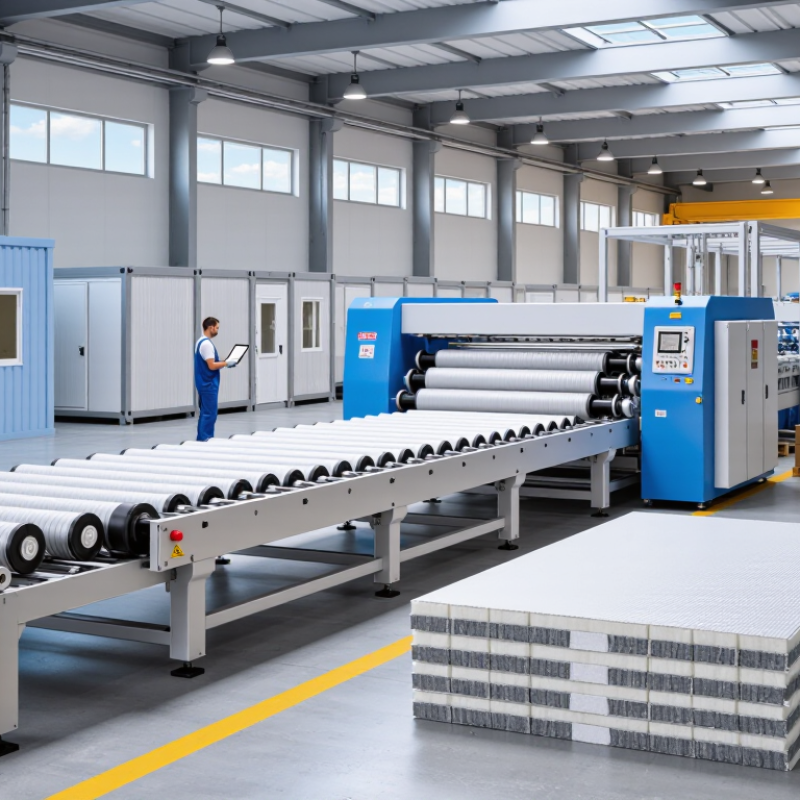
A sandwich panel roll forming machine is an integrated production system for making insulated wall and roof panels. It shapes metal sheets into accurate profiles, places an insulation core, and joins the layers under controlled pressure. The finished panel usually contains two coated steel skins and a core made from EPS, polyurethane, or mineral wool.
During operation, decoilers feed steel coils into leveling and roll forming stations. Guide rollers keep the edges aligned. The insulation unit controls core thickness and position. Adhesive application, pressing, cutting, and panel stacking follow in sequence. Sensors monitor speed, length, and alignment. Even a small gap can affect thermal performance and water resistance.
A reliable machine needs rigid frames, hardened rollers, stable temperature control, and accessible adjustment points. Operators should check coil width, coating thickness, adhesive curing, and cutting accuracy before full production. In practice, setup errors often cause more waste than mechanical failure. It is not a magic box.
Different projects require different panel thicknesses, profiles, and production speeds. A line designed for roofing panels may not handle wall panels efficiently. Maintenance also matters. Dust, adhesive residue, and loose fasteners can gradually reduce accuracy. Some specifications look impressive on paper, yet real output depends on operator skill, material quality, and factory conditions. Testing sample panels remains necessary.
How China’s Top 10 Brands Are Selected and Evaluated
China Top 10 Sandwich Panel Roll Forming Machine Brands
How China’s Top 10 Brands Are Selected and Evaluated
A practical ranking begins with evidence, not advertising claims. We examine manufacturing experience, engineering records, and verified customer applications. Factory visits reveal details that brochures often hide. We watch a complete production run, from coil feeding to panel cutting. The assessment includes roller alignment, frame strength, forming accuracy, and control system response. We also check whether operators can adjust the line without excessive downtime.
Performance is measured with real materials and defined settings. Test panels are checked for width tolerance, surface marks, joint quality, and cutting precision. We record line speed, material thickness, power use, and changeover time. Service capability matters equally. Evaluators review installation support, spare-part access, training documents, and warranty handling. Customer interviews add useful context, especially after several years of operation. Numbers can mislead.
The selection process combines technical scores with field experience. A machine may run quickly but create unstable edges. Another may offer strong accuracy but require complicated maintenance. These trade-offs receive careful attention. We also consider documentation quality and communication during technical discussions. Reliable manufacturers explain limitations instead of promising perfect results. Not every claim survives testing. Scoring is never completely neutral, because applications, materials, and factory conditions differ. For that reason, the ranking remains a researched reference rather than an absolute judgment.
Profiles of China’s Top 10 Sandwich Panel Roll Forming Machine Brands
China’s top ten sandwich panel roll forming machine brands differ in engineering depth, product focus, and service quality. Some manufacturers build complete lines for EPS, rock wool, or polyurethane panels. Others concentrate on compact machines for smaller workshops. Their profiles reveal practical differences beyond catalog photos.
The strongest suppliers usually combine rigid frame design, accurate roller machining, and stable feeding systems. One group is known for high-speed lines with automatic cutting and stacking. Another favors flexible equipment for varied panel widths and thicknesses. Several manufacturers provide insulated control cabinets, remote troubleshooting, and operator training. A few focus on export-ready layouts, multilingual manuals, and reinforced packaging. Cost-oriented producers may offer useful basic models, but their electrical components require closer inspection. This matters.
Tips: Ask for recent production videos, panel samples, tolerance data, and a clear spare-parts list. Check whether the machine handles your core material, thickness range, and local power standard. A low quotation can hide manual adjustments, slower output, or limited technical support.
From hands-on evaluation, reliable suppliers explain limitations instead of promising perfect performance. Experienced buyers should inspect roller alignment, welding quality, cutting accuracy, and emergency-stop functions. Some advertised production speeds seem optimistic under real factory conditions. That gap deserves careful testing before payment. A trial using your own steel coil can expose problems early, especially edge deformation, uneven bonding, or unstable panel length.
Key Technologies and Features Compared Across Leading Brands
China Top 10 Sandwich Panel Roll Forming Machine Brands
China’s leading ten supplier groups compete through measurable engineering, not only advertised speed. Grand View Research estimates the global sandwich panel market could reach about USD 22 billion by 2030, with insulation demand driving new production lines. This growth makes machine stability more important than headline output.
Servo-controlled decoilers improve coil alignment and reduce surface scratches. Closed-loop PLC systems can maintain forming accuracy during long production runs. Many advanced lines combine automatic feeding, multiple roll-forming stations, hydraulic cutting, and synchronized panel lamination. Rock wool, EPS, and polyurethane panels require different pressure, heating, and adhesive controls. One setting cannot suit every core.
Speed matters.
However, published speeds often exclude setup time, material changes, and rejected panels. Real evaluation should measure usable output, dimensional tolerance, and changeover minutes. European Machinery Directive principles and ISO 12100 risk-assessment methods also provide useful safety references, even when equipment is manufactured in China. A 2024 report from MarketsandMarkets identifies automation and energy efficiency as major manufacturing priorities, supporting demand for servo drives, remote diagnostics, and lower-power hydraulic systems. Yet software quality varies. Operators still need clear alarms and manual recovery steps.
The strongest machines usually offer adjustable roller spacing, digital recipe storage, edge-position correction, and traceable production records. Buyers should request test rolls using their own steel thickness and insulation core. That practical check exposes weaknesses quickly. A perfect specification sheet is not proof of reliable production.
China Top 10 Sandwich Panel Roll Forming Machine Brands - Key Technologies and Features Compared Across Leading Brands
Anonymous industry benchmark of commonly specified technologies and performance ranges for sandwich panel roll forming lines manufactured in China.
| No. |
Technology or Feature |
Typical Specification in China |
Applicable Panel or Material |
Main Production Benefit |
Common Market Availability |
| 1 |
Panel Thickness Range |
Approximately 30–250 mm, depending on the panel system and machine configuration |
EPS, rock wool, glass wool, and PIR/PU sandwich panels |
Allows one production line to serve standard wall, roof, and cold-room applications |
Widely available |
| 2 |
Effective Sheet Width |
Commonly 1,000–1,200 mm; custom widths are possible for specific projects |
Pre-painted steel, galvanized steel, and aluminum-coated steel sheets |
Matches the most frequently used construction panel dimensions |
Widely available |
| 3 |
Raw Material Thickness |
Usually 0.30–0.80 mm for metal facings |
Color-coated steel, galvanized steel, and other coil-fed sheet materials |
Supports lightweight architectural panels while maintaining forming stability |
Widely available |
| 4 |
Roll Forming Speed |
Approximately 8–20 m/min; actual speed depends on profile, thickness, and bonding process |
Roof and wall panel profiles with ribbed, corrugated, or concealed-joint surfaces |
Improves output while reducing manual handling between forming stages |
Widely available |
| 5 |
Roller and Shaft Construction |
Machined steel rollers with hardened or treated surfaces; shafts commonly use medium-carbon alloy steel |
Continuous roll forming of coated and galvanized steel sheets |
Reduces profile deformation, surface scratching, and long-term alignment drift |
Standard feature |
| 6 |
Automatic Length Measurement and Cutting |
Encoder-based measurement with hydraulic or servo-controlled flying cut-off; typical tolerance is about ±1–2 mm under stable conditions |
Fixed-length wall, roof, and insulated panel production |
Improves repeatability and reduces material waste at the cutting stage |
Common upgrade |
| 7 |
Control System |
PLC with touchscreen HMI, recipe storage, emergency-stop circuits, and inverter or servo drive control |
Single-profile and multi-profile production lines |
Simplifies parameter setting, fault diagnosis, and operator training |
Widely available |
| 8 |
Core Material Processing |
Options may include EPS block cutting, rock wool positioning, adhesive application, and panel pressing |
EPS, mineral wool, glass wool, PIR, and PU-based sandwich panels |
Enables integrated or semi-integrated production instead of separate assembly operations |
Configuration dependent |
| 9 |
Decoiler and Feeding Capacity |
Typical decoiler capacity is 5–10 tonnes, with hydraulic expansion and automatic or assisted loading options |
Coils used for continuous panel facing production |
Supports longer production runs and reduces coil-change frequency |
Widely available |
| 10 |
Safety and Maintenance Design |
Guarding around rotating parts, overload protection, emergency stops, accessible lubrication points, and modular electrical cabinets |
Industrial production environments operating single-shift or multi-shift schedules |
Improves operator safety, service access, uptime, and equipment lifecycle management |
Essential specification |
Specifications are representative industry ranges rather than performance claims for any individual manufacturer. Final output, dimensional accuracy, and panel quality depend on profile design, raw material condition, core material, adhesive system, line speed, and commissioning.
How to Choose the Right Chinese Brand for Your Production Needs
China Top 10 Sandwich Panel Roll Forming Machine Brands
How to Choose the Right Chinese Brand for Your Production Needs
Choosing a Chinese sandwich panel roll forming machine brand requires more than comparing prices. Your panel thickness, core material, working speed, and factory space should guide the decision. Ask for a complete layout drawing, not only a machine photograph. A reliable manufacturer should explain forming stations, motor capacity, roller material, and control system settings clearly.
I have found that a live factory test reveals details brochures often hide. Watch the machine produce several panels continuously. Check edge alignment, surface scratches, cutting accuracy, and noise levels. Request samples using your actual steel thickness and panel design. A small error may become expensive after thousands of meters. It happens more often than buyers expect.
Technical evidence matters. Review inspection records, component datasheets, installation procedures, and warranty terms. Confirm whether remote troubleshooting and spare parts support are available in your region. Ask for references from factories with similar output requirements. Independent factory audits can also reduce uncertainty. Still, no supplier is perfect; delivery delays or communication gaps may occur. Put response times, training, acceptance standards, and payment stages into a written contract. The best choice is not always the fastest machine. It is the supplier that offers measurable performance, transparent engineering, and dependable support after installation.
FAQS
It produces insulated wall and roof panels with metal skins and an insulation core. The core may be EPS, polyurethane, or mineral wool.
Decoilers feed steel coils into leveling and forming stations. Rollers shape the sheets. Adhesive, insulation, pressing, cutting, and stacking follow.
Guide rollers keep panel edges aligned. Even a small gap can reduce thermal performance and water resistance.
Operators should control steel thickness, coil width, core thickness, adhesive curing, pressure, temperature, and cutting length. One setting cannot suit every core.
Not always. Published speed may exclude setup time, material changes, and rejected panels. Measure usable output instead.
Watch several panels run continuously. Check edge alignment, surface scratches, cutting accuracy, noise, and dimensional tolerance.
Use your actual steel thickness, panel design, and insulation core for testing. Request layout drawings, component data, and sample panels.
Confirm installation, operator training, spare parts, remote troubleshooting, warranty terms, and response times. Put these details in the contract.
Dust, adhesive residue, and loose fasteners can gradually affect forming quality. Regular cleaning and adjustment checks are necessary.
No. Real performance depends on materials, factory conditions, software, and operator skill. A perfect sheet is not proof.
Conclusion
This article provides a practical guide to China Sandwich Panel Roll Forming Machine solutions and explains how these machines support efficient, consistent, and cost-effective sandwich panel production. It first introduces the machine’s structure, working process, and main applications, then outlines the standards used to evaluate leading Chinese manufacturers, including product quality, forming accuracy, automation, production capacity, technical support, customization, and value for investment.
The article also presents an overview of ten representative Chinese brands without focusing on brand names, highlighting their general strengths and market positioning. It compares key technologies and features such as material compatibility, panel dimensions, control systems, forming speed, insulation integration, safety functions, and maintenance requirements. Finally, it offers practical advice for selecting the right supplier according to production volume, panel specifications, factory conditions, budget, after-sales service, and future expansion plans.