For global buyers, choosing the right Eps Sandwich Panel Lines is a production decision, not merely an equipment purchase. In 2026, manufacturers must examine panel thickness, core density, adhesive control, heating stability, and output consistency. A line may promise 2,000 square meters daily, yet real production can fall sharply during material changes or maintenance. That gap matters.
Peter Kurtz, CEO of Kurtz Ersa and a long-time specialist in foam-processing machinery, states, “Efficiency begins with process stability, not maximum speed.” This principle deserves attention. A reliable line should maintain even EPS bonding, clean cutting edges, accurate panel dimensions, and predictable energy consumption. Buyers should also inspect conveyor alignment, hydraulic response, control-system access, and spare-parts availability. These details often decide whether a factory runs smoothly after installation.
This guide compares leading Eps Sandwich Panel Lines for international buyers through practical criteria. It considers factory experience, technical support, automation, safety design, operating cost, and expansion potential. Supplier claims still require verification. Ask for production samples, factory references, performance records, and a detailed commissioning plan. Some evaluations remain imperfect because local labor skills, climate, electricity quality, and raw-material behavior can change results. A line performing well in one country may need different settings elsewhere. Careful testing is essential. Speed attracts attention, but stable panels create lasting value.
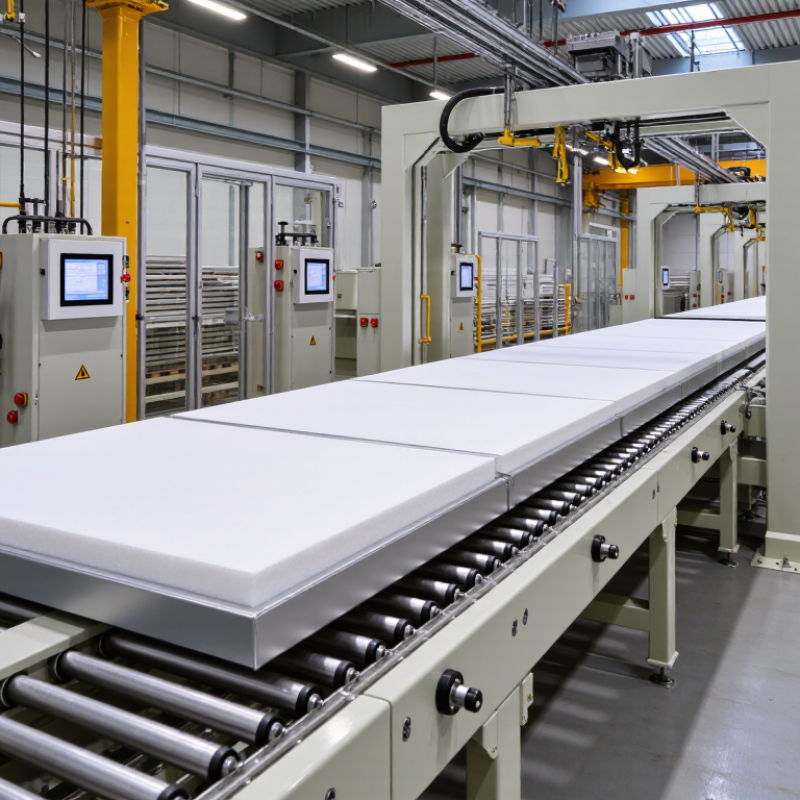
EPS Sandwich Panel Fundamentals: 12–20 kg/m³ Core Density and 0.035–0.040 W/m·K Conductivity
2026 Best EPS Sandwich Panel Lines for Global Buyers
EPS sandwich panels usually rely on a core density of 12–20 kg/m³. This range affects stiffness, weight, cutting accuracy, and thermal performance. At 0.035–0.040 W/m·K, the core can provide practical insulation for walls and roofs when thickness is selected correctly. Lower density may reduce cost, but it can also weaken edge stability and increase dimensional variation.
A reliable panel line must control pre-expansion, bead aging, block molding, cutting, and lamination. During production checks, operators should measure density from several core locations, not only from the center. A 15 kg/m³ target means little if corners fall below specification. Temperature, steam pressure, and aging time need stable records. Small process changes matter.
Panel lines should also support consistent adhesive coating and controlled pressing. Uneven pressure can leave visible gaps beneath the steel sheet. Those gaps become more serious in humid or windy environments. Thermal conductivity should be verified through recognized laboratory methods, such as EN 12667, rather than estimated from machine settings. Fire classification, load capacity, surface coatings, and local building requirements require separate review because EPS performance is not identical in every assembly. I would not treat one successful test panel as proof of long-term reliability. Repeated sampling is slower, but more honest.
2026 Best EPS Sandwich Panel Lines for Global Buyers
Representative EPS core specifications are shown across the commonly used density range of 12–20 kg/m³. Thermal conductivity generally improves as density increases, with typical values ranging from approximately 0.040 to 0.035 W/m·K. Actual performance may vary by raw material, production process, temperature, and testing standard.
2026 EPS Panel Line Workflow: Profiling, Foaming, Bonding, Cutting, and Stacking
2026 Best EPS Sandwich Panel Lines for Global Buyers
A reliable EPS panel line follows a controlled path:
profiling, foaming, bonding, cutting, and stacking.
During profiling, galvanized or pre-painted steel sheets pass through forming rollers. Each roller station should maintain alignment without scratching the surface. Small deviations can later create open joints.
Foaming begins with pre-expanding EPS beads using steam, pressure, and measured residence time. The beads need stable density before entering the panel core.
After conditioning, the material reaches the bonding section. Here, adhesive coverage must remain even across the panel width.
Operators should check temperature, pressure, and sheet speed together. A clean adhesive pattern matters more than excessive application. It reduces weak spots and unnecessary waste.
The bonded panel then enters a continuous cutter or a fixed-length cutting unit. Accurate length depends on synchronized feeding and sharp blades. Dust removal is important around the cutting area.
Finished panels move to stacking equipment, where gentle handling protects edges and corners. In practical production, the line may need adjustment after humidity or raw-material changes.
No setting stays perfect forever. Buyers should request trial panels, density records, thickness checks, and joint inspections before shipment. I would also examine access for maintenance, because a fast line becomes expensive when a simple roller is difficult to replace.
Key Line Specifications: 50–250 mm Panel Thickness and 15–30 m/min Speed
For global buyers, EPS sandwich panel lines should be judged by usable output, not speed alone. The key range is 50–250 mm panel thickness, covering roofs, walls, cold rooms, and industrial buildings. A stable line should reach 15–30 m/min while maintaining consistent foam density, adhesive coverage, and surface alignment. Thicker panels usually require slower feeding and tighter pressure control. Thin panels can run faster, but they may show dents or uneven edges if calibration is poor.
In production, operators should inspect the preheating zone, roller spacing, cutting accuracy, and automatic stacking system. These details affect daily output more than a headline speed. From practical line evaluations, speed variation often appears when raw material density changes. That issue is easy to underestimate. Reliable equipment should include adjustable forming rollers, temperature monitoring, emergency stops, and documented quality checks. Buyers should also verify electrical standards, installation conditions, and local safety requirements before ordering.
Tips: Request trial production with both 50 mm and 250 mm panels. Measure thickness at several points, not only at the center. Test speeds at 15, 20, and 30 m/min. Check edge straightness after cooling. Ask for maintenance records and operator training details. A faster line is not always better. Sometimes, controlled speed produces fewer rejected panels and steadier long-term results.
Selecting an EPS Sandwich Panel Line by Capacity, Automation, Energy Use, and ROI
2026 Best EPS Sandwich Panel Lines for Global Buyers
Selecting an EPS sandwich panel line requires more than maximum output. Capacity, automation, energy use, and ROI must match the buyer’s actual market.
The UNEP 2024 Global Status Report states that buildings consume 32% of global energy and produce 34% of energy-related carbon emissions. This makes panel insulation performance commercially important, not merely technical. A medium-capacity line may suit regional demand better than a high-speed system. Check hourly output, panel thickness range, changeover time, and reject rates. In practice, a line producing 2,000 panels daily may outperform a faster line if it wastes less material. Automation should reduce manual handling and stabilize thickness, adhesive application, and cutting accuracy. However, excessive automation can increase maintenance skills and spare-parts costs.
Energy data deserves close attention. The International Energy Agency reports that buildings represent about 30% of global final energy consumption. Compare installed power, compressed-air demand, heating zones, and energy used per square meter of panel. ROI calculations should include labor, scrap, maintenance, financing, and downtime. Payback claims often look too perfect. Markets change. Electricity prices change faster than many forecasts.
Tips: Request twelve months of tested production data. Ask for energy use at your target thickness, not laboratory speed. Calculate ROI with conservative sales volume and a 10% downtime allowance. A site visit is useful, but it cannot replace independent acceptance testing.
2026 Best EPS Sandwich Panel Lines for Global Buyers - Selecting an EPS Sandwich Panel Line by Capacity, Automation, Energy Use, and ROI
Comparative benchmark for typical EPS sandwich panel production configurations
Indicative 2026 technical and commercial benchmarks; actual performance depends on panel specifications, raw materials, operating hours, labor costs, and local electricity prices.
| Line Configuration |
Typical Output
(m²/h) |
Panel Thickness
(mm) |
Effective Line Speed
(m/min) |
Recommended Annual Capacity
(m²/year) |
Automation Level |
Electrical Consumption
(kWh/m²) |
Indicative Investment
(USD) |
Estimated Payback
(Years) |
Best Fit |
| Entry-Level Manual Line |
80–150 |
30–150 |
1.5–3.0 |
100,000–250,000 |
Basic; manual feeding and cutting |
0.18–0.30 |
80,000–180,000 |
2.5–4.5 |
Small regional producers and start-ups |
| Semi-Automatic Standard Line |
150–280 |
40–200 |
3.0–5.5 |
250,000–500,000 |
Semi-automatic; PLC-controlled cutting |
0.14–0.24 |
180,000–350,000 |
2.0–3.5 |
General construction-panel demand |
| Automatic Mid-Speed Line |
280–450 |
50–250 |
5.0–8.0 |
500,000–900,000 |
High; automatic dosing, laminating, and stacking |
0.11–0.19 |
350,000–650,000 |
1.8–3.0 |
Established suppliers with steady orders |
| High-Speed Continuous Line |
450–700 |
50–250 |
8.0–12.0 |
900,000–1,400,000 |
Advanced; servo drives and automatic material handling |
0.09–0.16 |
650,000–1,100,000 |
1.7–2.8 |
Large-volume domestic or export production |
| High-Precision Flexible Line |
220–420 |
30–300 |
4.0–8.0 |
400,000–850,000 |
Advanced; recipe management and quick changeover |
0.12–0.21 |
450,000–850,000 |
2.0–3.5 |
Custom sizes, frequent product changes, and premium projects |
| Energy-Optimized Line |
250–500 |
50–250 |
5.0–9.0 |
500,000–1,000,000 |
High; variable-frequency drives and heat-loss reduction |
0.07–0.13 |
500,000–950,000 |
1.8–3.2 |
Markets with high electricity costs or energy targets |
| Integrated Automated Factory Line |
600–1,000 |
50–250 |
10.0–15.0 |
1,200,000–2,000,000 |
Very high; MES-ready production and robotic stacking |
0.08–0.14 |
1,000,000–1,800,000 |
2.0–3.5 |
Multi-shift plants serving large construction markets |
Benchmark assumptions:
Payback estimates assume 70%–85% utilization, two production shifts per day, 300 operating days per year, stable demand, and a blended contribution margin of approximately USD 1.50–3.50 per m². Investment ranges generally exclude land, building construction, import duties, taxes, working capital, and major utility upgrades.
Conclusion
Eps Sandwich Panel Lines are integrated production systems designed to manufacture lightweight, insulated panels with consistent quality and efficient output. Using EPS cores with a typical density of 12–20 kg/m³ and thermal conductivity of 0.035–0.040 W/m·K, the process generally includes surface profiling, foam preparation, adhesive bonding, precision cutting, and automatic stacking. Depending on the configuration, these lines can produce panels from 50 to 250 mm thick at speeds of approximately 15–30 m/min.
For global buyers, selecting the right line requires more than comparing production speed. Key evaluation criteria include dimensional tolerance, bonding or adhesion strength, and fire-performance requirements suited to the target market. Capacity planning, automation level, energy consumption, maintenance needs, and expected return on investment should also be assessed together. A well-matched EPS panel line can improve product consistency, reduce material waste, support stable operation, and provide scalable manufacturing performance for different construction applications.